RRB NTPC · Question 35
Read the given statements and conclusions carefully. Assuming that the information given in the statements is true, even if it appears to be at variance with commonly known facts, decide which of the given conclusion(s) logically follow(s) from the statements. Statements: All gorillas are monkeys. Some monkeys are baboons. All baboons are chimpanzees. Conclusions: (I) All chimpanzees are monkeys. (II) Some chimpanzees are gorillas.
Show answer & explanationShow explanation
Answer: (A) Neither conclusion (I) nor (II) follows.
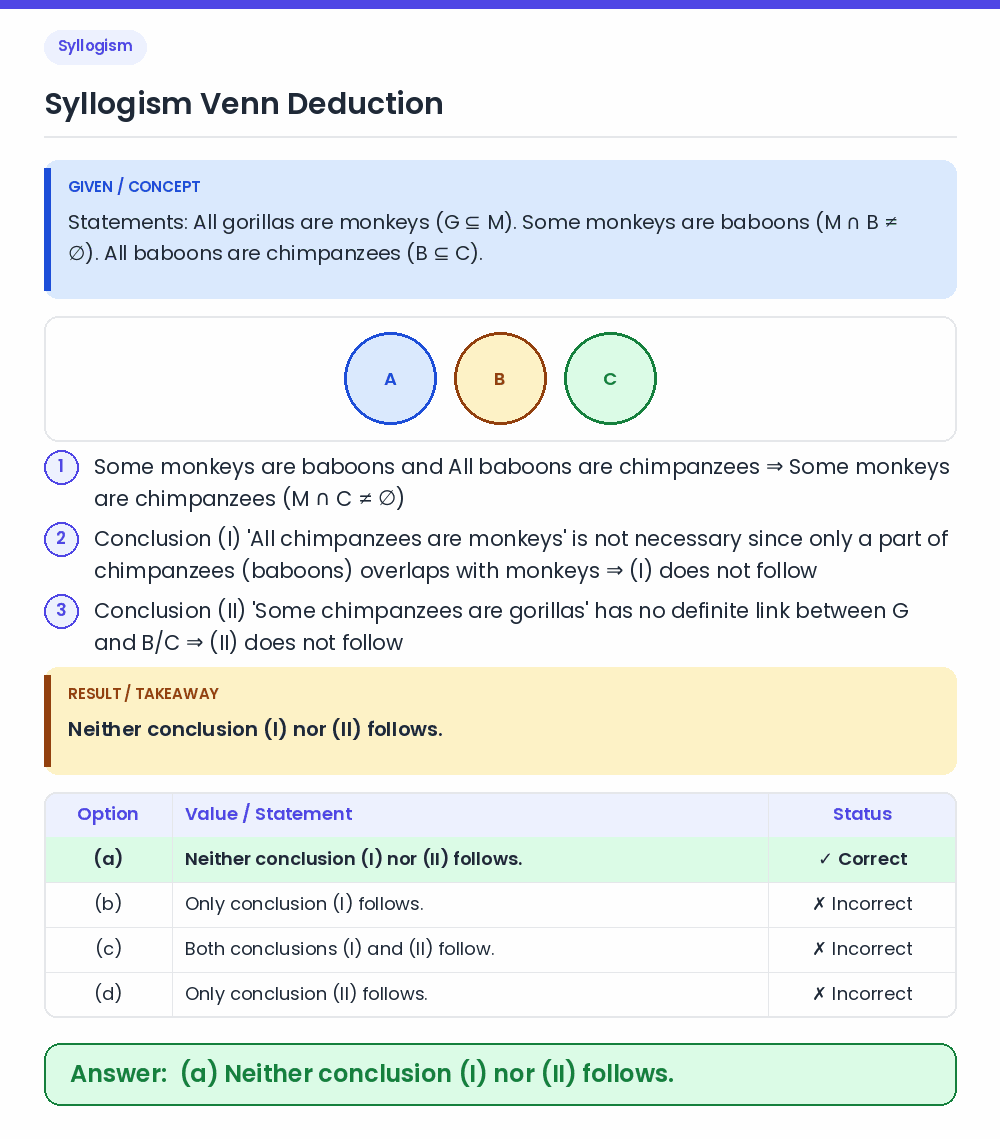
GIVEN / CONCEPT: Statements: All gorillas are monkeys (G ⊆ M). Some monkeys are baboons (M ∩ B ≠ ∅). All baboons are chimpanzees (B ⊆ C). Step 1 (Relation / Equation): Some monkeys are baboons and All baboons are chimpanzees ⇒ Some monkeys are chimpanzees (M ∩ C ≠ ∅) Step 2 (Simplification / Calculation): Conclusion (I) 'All chimpanzees are monkeys' is not necessary since only a part of chimpanzees (baboons) overlaps with monkeys ⇒ (I) does not follow Step 3 (Verification / Deduction): Conclusion (II) 'Some chimpanzees are gorillas' has no definite link between G and B/C ⇒ (II) does not follow RESULT / TAKEAWAY: Neither conclusion (I) nor (II) follows. Correct Answer: (a) Neither conclusion (I) nor (II) follows.