RRB NTPC · Question 61
A quadratic polynomial f(x) gives a remainder of 5 when divided by (x - 2), and of -3 when divided by (x - 4). If f(x) is of the form ax² + bx + c and the leading coefficient is 1, then which of the following is the correct quadratic equation f(x)=0?
Show answer & explanationShow explanation
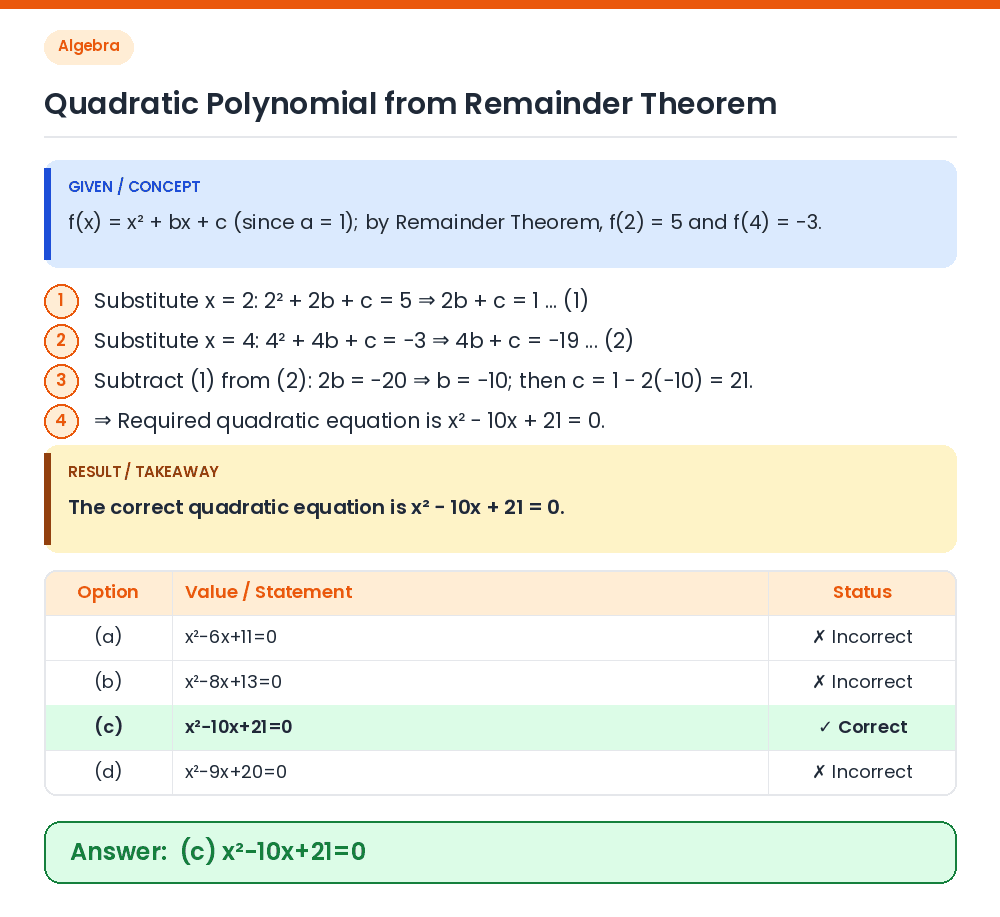
Answer: (C) x²−10x+21=0
GIVEN / CONCEPT: f(x) = x² + bx + c (since a = 1); by Remainder Theorem, f(2) = 5 and f(4) = −3. Substitute x = 2: 2² + 2b + c = 5 ⇒ 2b + c = 1 ... (1) Substitute x = 4: 4² + 4b + c = −3 ⇒ 4b + c = −19 ... (2) Subtract (1) from (2): 2b = −20 ⇒ b = −10; then c = 1 − 2(−10) = 21. Verification / Deduction: ⇒ Required quadratic equation is x² − 10x + 21 = 0. RESULT / TAKEAWAY: The correct quadratic equation is x² − 10x + 21 = 0. Correct Answer: (c) x²−10x+21=0