RRB NTPC · Question 92
In this question, a question is followed by two statements numbered (I) and (II). You have to decide whether the data provided in the statements are sufficient to answer the question. Read both the statements and decide the appropriate answer. Q. Five people – Riya, Meena, Tanu, Sunita, and Kavita – are sitting in a row facing north. Who is sitting exactly in the middle of the row? (I) Tanu sits immediately to the right of Meena, and Sunita sits immediately to the right of Tanu. (II) Riya is at one of the ends, and Kavita sits immediately to the left of Riya.
Show answer & explanationShow explanation
Answer: (A) Both statements I and II together (and not statement I alone or statement II alone) are sufficient to answer the question
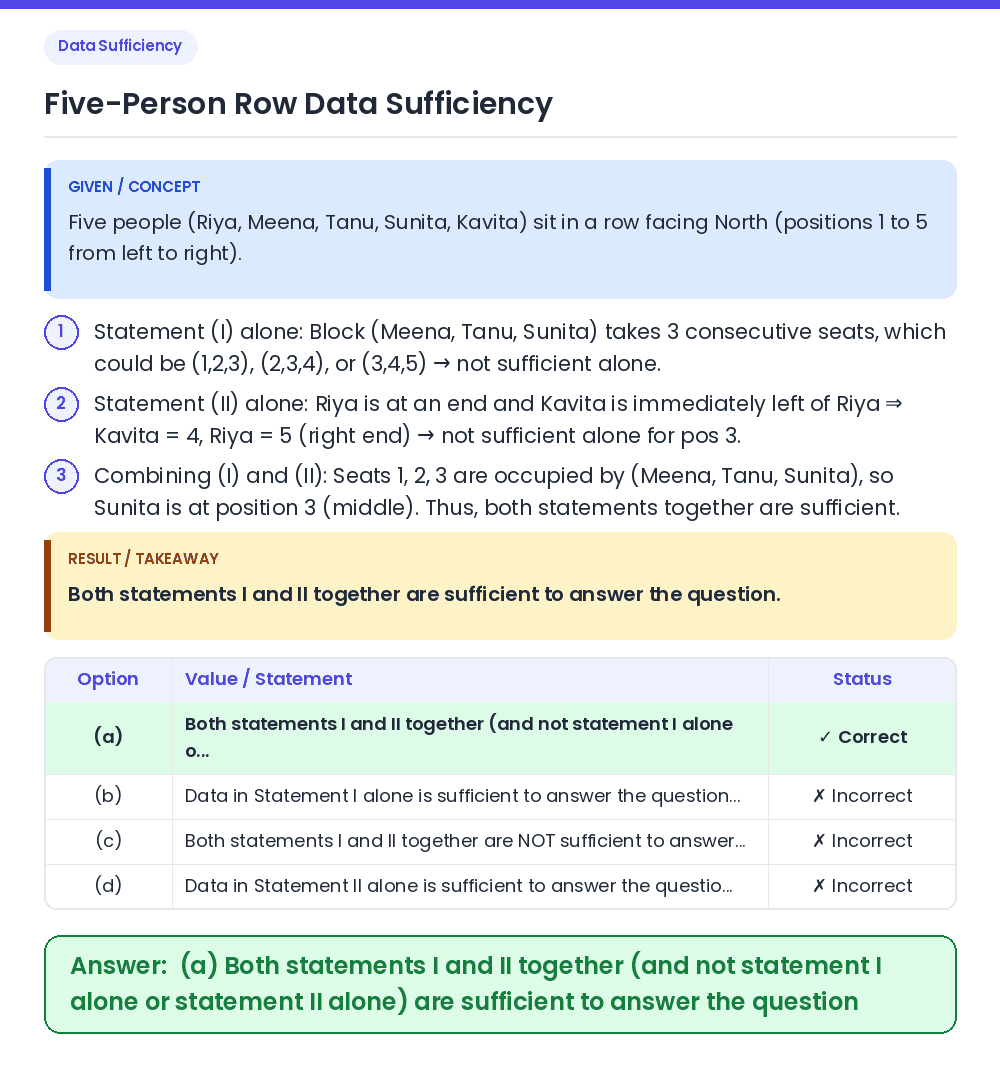
GIVEN / CONCEPT: Five people (Riya, Meena, Tanu, Sunita, Kavita) sit in a row facing North (positions 1 to 5 from left to right). Statement (I) alone: Block (Meena, Tanu, Sunita) takes 3 consecutive seats, which could be (1,2,3), (2,3,4), or (3,4,5) → not sufficient alone. Statement (II) alone: Riya is at an end and Kavita is immediately left of Riya ⇒ Kavita = 4, Riya = 5 (right end) → not sufficient alone for pos 3. Combining (I) and (II): Seats 1, 2, 3 are occupied by (Meena, Tanu, Sunita), so Sunita is at position 3 (middle). Thus, both statements together are sufficient. RESULT / TAKEAWAY: Both statements I and II together are sufficient to answer the question. Correct Answer: (a) Both statements I and II together (and not statement I alone or statement II alone) are sufficient to answer the question