RRB NTPC · Question 50
Below are given two sets of numbers. In each set of numbers, a certain mathematical operation on the first number results in the second number. Similarly, a certain mathematical operation on the second number results in the third number, and so on. Which of the given options follows the same set of operations as in the question? (NOTE: A two-/three-digit number cannot be broken into individual digits for operations, e.g. if 37 is followed by 10, the operation cannot be 3 + 7, as a two-digit number cannot be broken into individual digits.) 50 – 10 – 5 – 15 ; 200 – 40 – 20 – 30
Show answer & explanationShow explanation
Answer: (D) 400 – 80 – 40 – 50
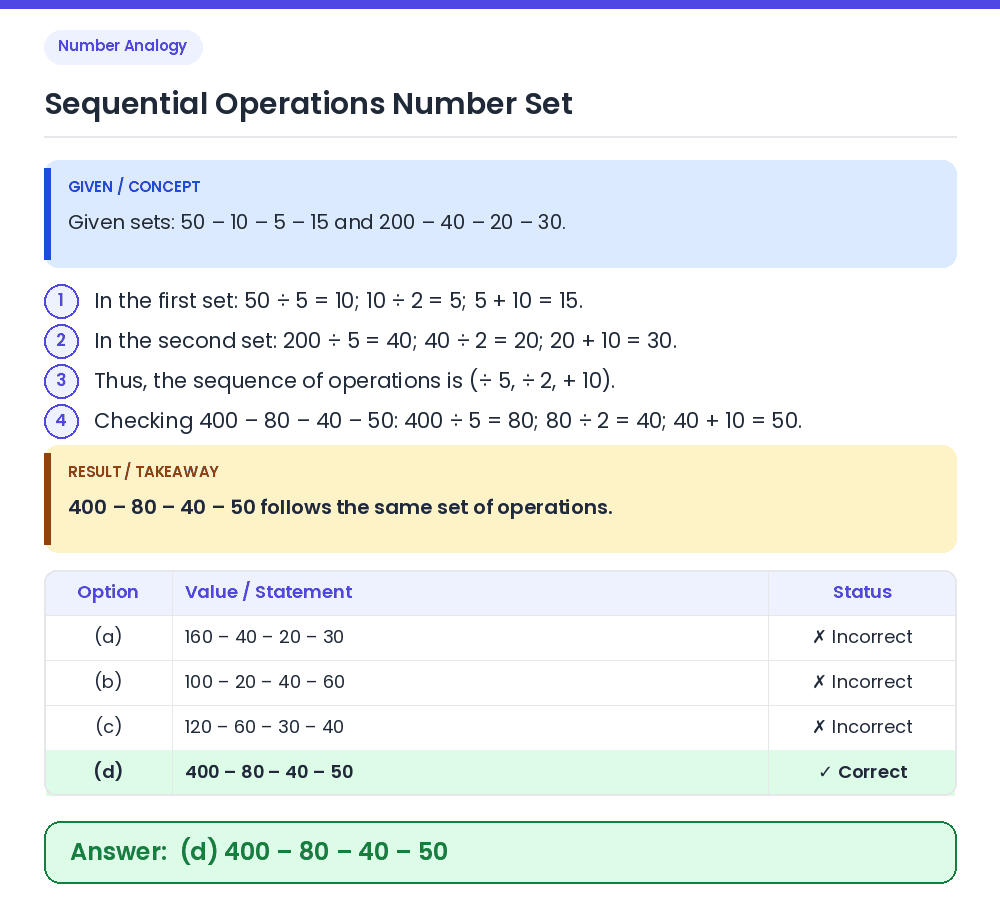
GIVEN / CONCEPT: Given sets: 50 – 10 – 5 – 15 and 200 – 40 – 20 – 30. In the first set: 50 ÷ 5 = 10; 10 ÷ 2 = 5; 5 + 10 = 15. In the second set: 200 ÷ 5 = 40; 40 ÷ 2 = 20; 20 + 10 = 30. Verification / Deduction: Thus, the sequence of operations is (÷ 5, ÷ 2, + 10). Checking 400 – 80 – 40 – 50: 400 ÷ 5 = 80; 80 ÷ 2 = 40; 40 + 10 = 50. RESULT / TAKEAWAY: 400 – 80 – 40 – 50 follows the same set of operations. Correct Answer: (d) 400 – 80 – 40 – 50