RRB NTPC · Question 61
In this question, a question is followed by two statements numbered (I) and (II). You have to decide whether the data provided in the statements are sufficient to answer the question. Read both the statements and decide the appropriate answer. Question: Among 5 trees, L, M, N, T and V each having a different height, which tree is the tallest? Statements: (I) M is taller than only two trees. T is immediately taller than N. (II) V is taller than N.
Show answer & explanationShow explanation
Answer: (C) Both statements I and II together are NOT sufficient to answer the question
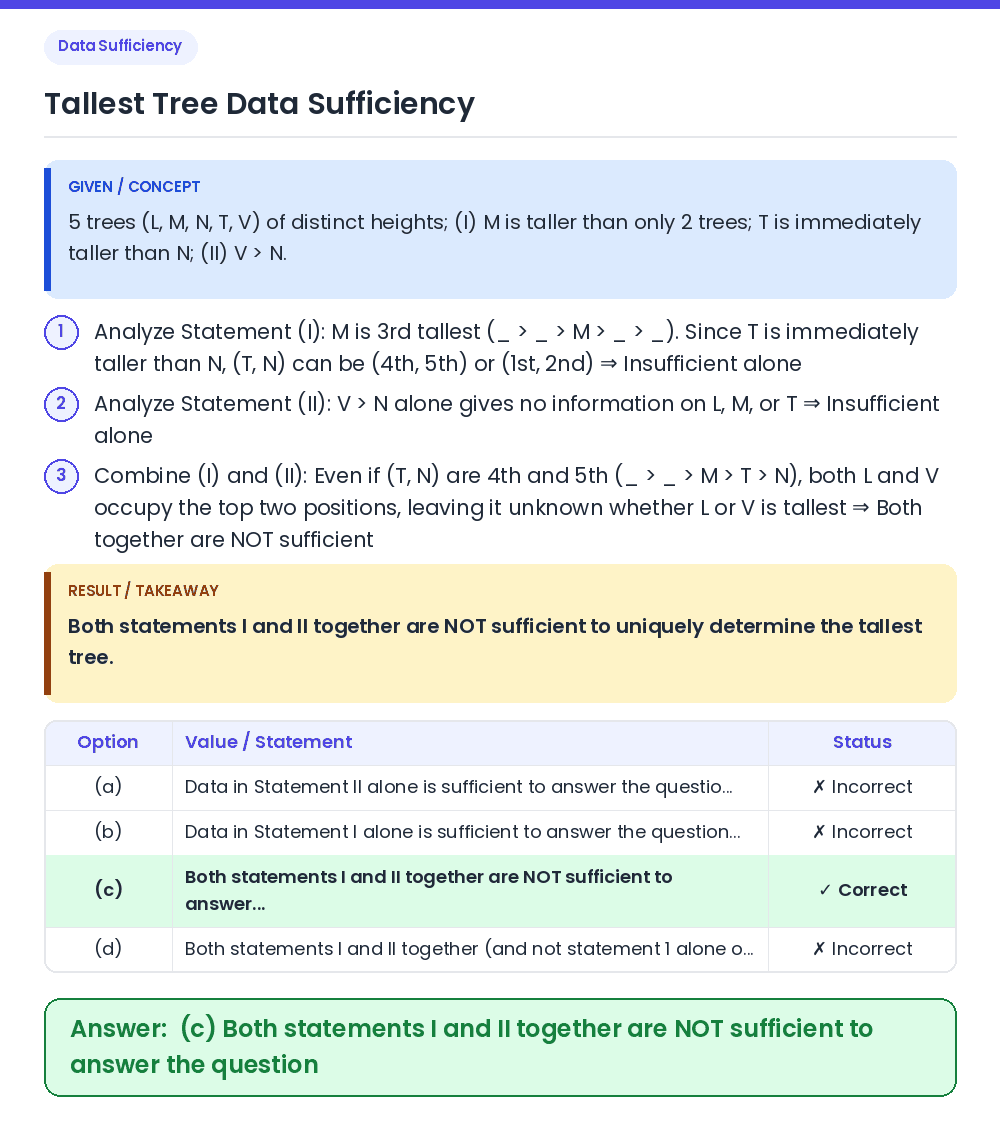
GIVEN / CONCEPT: 5 trees (L, M, N, T, V) of distinct heights; (I) M is taller than only 2 trees; T is immediately taller than N; (II) V > N. Analyze Statement (I): M is 3rd tallest (_ > _ > M > _ > _). Since T is immediately taller than N, (T, N) can be (4th, 5th) or (1st, 2nd) ⇒ Insufficient alone Analyze Statement (II): V > N alone gives no information on L, M, or T ⇒ Insufficient alone Combine (I) and (II): Even if (T, N) are 4th and 5th (_ > _ > M > T > N), both L and V occupy the top two positions, leaving it unknown whether L or V is tallest ⇒ Both together are NOT sufficient RESULT / TAKEAWAY: Both statements I and II together are NOT sufficient to uniquely determine the tallest tree. Correct Answer: (c) Both statements I and II together are NOT sufficient to answer the question