RRB NTPC · Question 29
Which climatic factor plays the most significant role in shaping the distribution of natural vegetation across India?
Show answer & explanationShow explanation
Answer: (B) Annual precipitation (>250 cm)
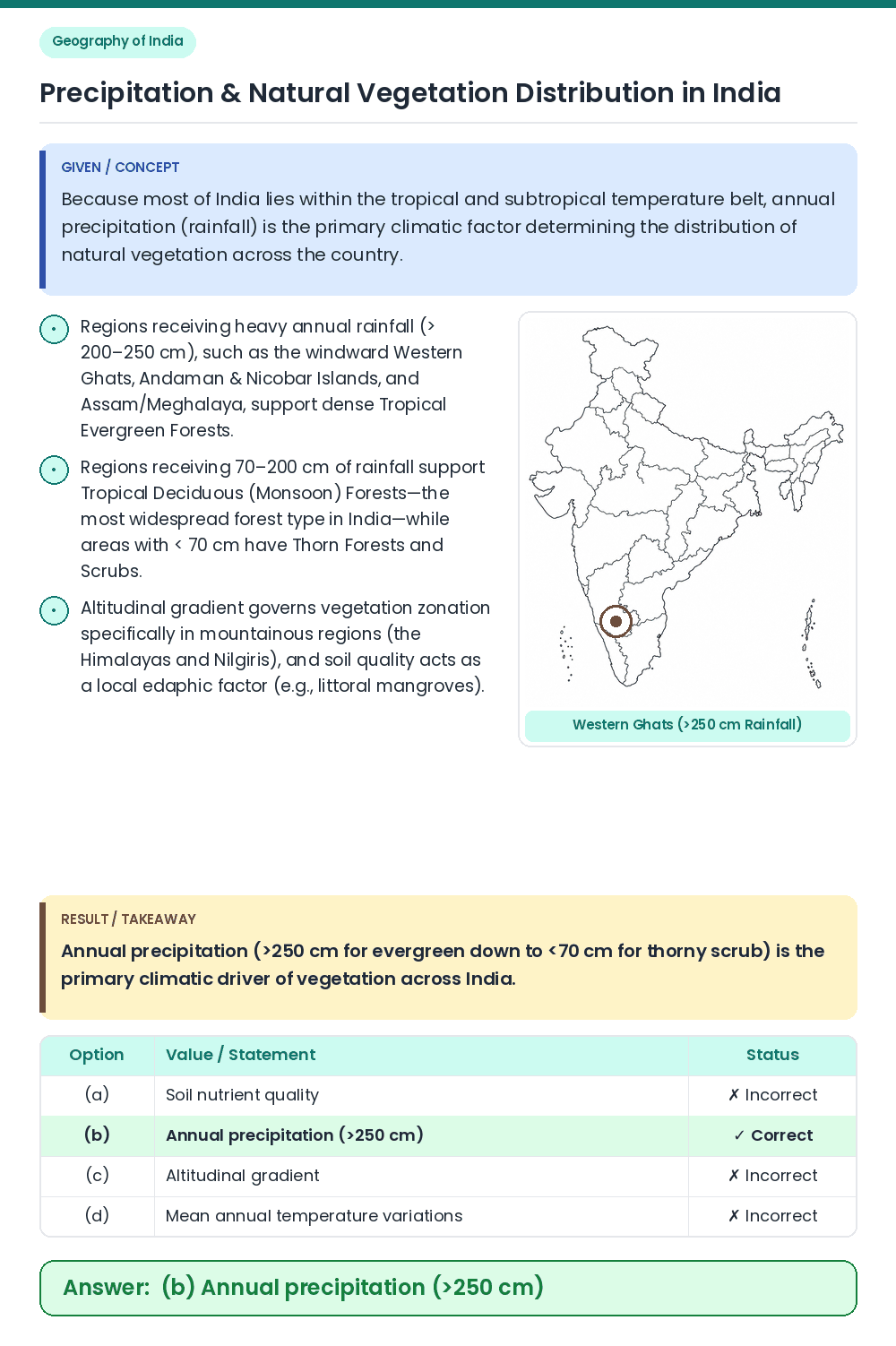
• Because most of India lies within the tropical and subtropical temperature belt, annual precipitation (rainfall) is the primary climatic factor determining the distribution of natural vegetation across the country. • Annual precipitation (>250 cm for evergreen down to <70 cm for thorny scrub) is the primary climatic driver of vegetation across India. Related Facts: • Regions receiving heavy annual rainfall (> 200–250 cm), such as the windward Western Ghats, Andaman & Nicobar Islands, and Assam/Meghalaya, support dense Tropical Evergreen Forests. • Regions receiving 70–200 cm of rainfall support Tropical Deciduous (Monsoon) Forests—the most widespread forest type in India—while areas with < 70 cm have Thorn Forests and Scrubs. • Altitudinal gradient governs vegetation zonation specifically in mountainous regions (the Himalayas and Nilgiris), and soil quality acts as a local edaphic factor (e.g., littoral mangroves). Correct Answer: (b) Annual precipitation (>250 cm)