SSC CGL – Combined Graduate Level Examination · Question 100
In the following passage, some words have been deleted. Read the passage carefully and select the most appropriate option to fill in each blank. Gandhi, (1)________ father of the Indian nation, practiced 'ahimsa' in his personal and political life. He firmly believed that non-violence is not meant merely for monks, saints and priests; it is for commoners too. If violence is the law of the (2)________-beasts, non-violence is the law of the civilised human species. 'The spirit of the brute is inactive and so he knows no law; he knows only physical might. The dignity of man requires obedience to a higher law, to strength of the spirit,' Gandhi said. Ahimsa, to Gandhiji, meant that one should love all; even (3)________ enemies. And the expression of love, ahimsa, should be in such a manner that it impresses itself indelibly upon the so-called enemy, and then the enemy must return that love. It is a practically (4)________ philosophy. Gandhi was realistic; he believed that non-violence provides the fullest protection to one's self-respect and sense of humour. It won't work in the defence of (5)________ gains and immoral acts. He called his marches off when people indulged in violence during protests for India's freedom. His faith in 'ahimsa' played an influential role in enabling the creation of an independent India in 1947, with minimum bloodshed, breaking the shackles framed by the British. Select the most appropriate option to fill in blank number 5.
Show answer & explanationShow explanation
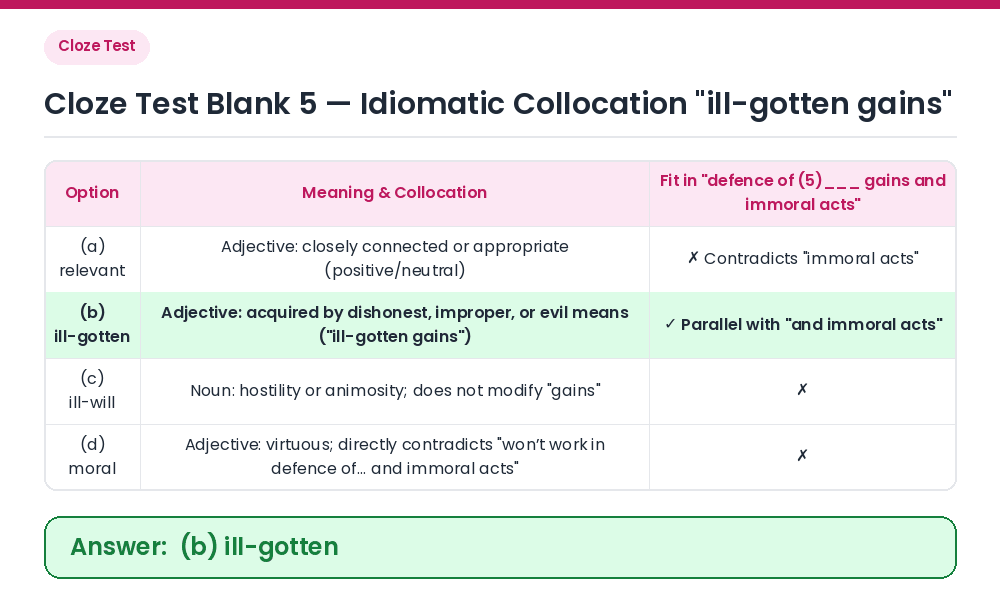
Answer: (B) ill-gotten
Collocation & Parallelism Rule: The blank modifies 'gains' and is paired with 'and immoral acts' as things that non-violence cannot be used to defend. The standard English idiom is 'ill-gotten gains' (wealth or benefits acquired by dishonest or unlawful means). Correct Answer: (b) ill-gotten