SSC CGL – Combined Graduate Level Examination · Question 3
Three statements are given, followed by three conclusions numbered I, II and III. Assuming the statements to be true, even if they seem to be at variance with commonly known facts, decide which of the conclusions logically follow(s) from the statements. Statements: No lotus is a daisy. All lotuses are tulips. All tulips are sunflowers. Conclusions: I. All daisies are tulips. II. Some sunflowers are daisies. III. No sunflower is a daisy.
Show answer & explanationShow explanation
Answer: (B) Either conclusion II or III follows
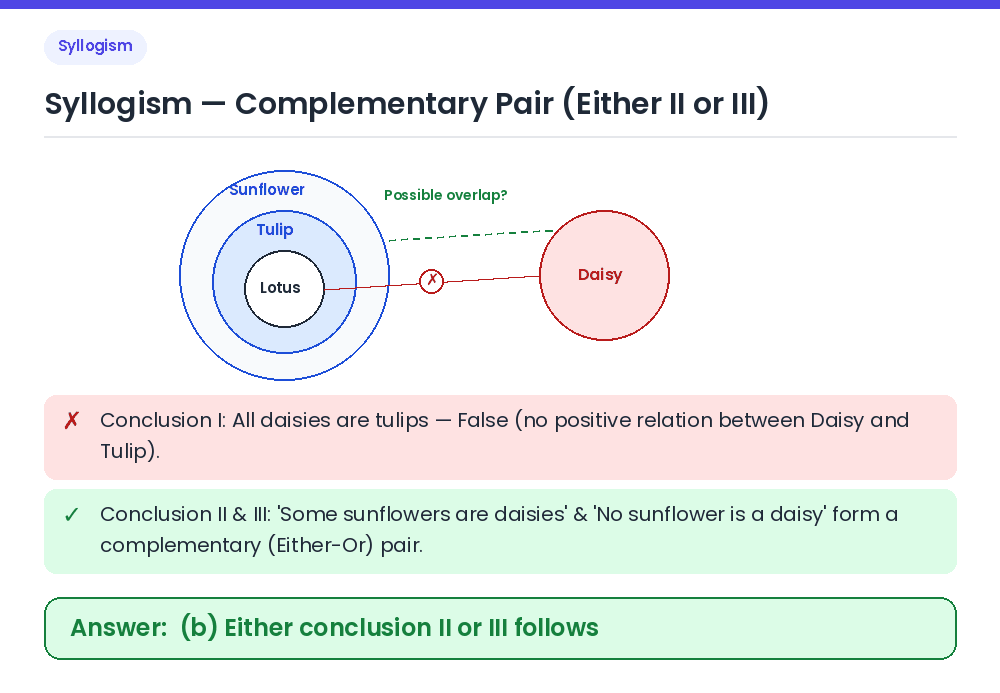
Combine the statements: All Lotuses are inside Tulips, and all Tulips are inside Sunflowers (Lotus ⊂ Tulip ⊂ Sunflower). No Lotus is a Daisy. Check Conclusion I: 'All daisies are tulips' does not follow because Daisies are only known to be disjoint from Lotuses; they have no definite relation with Tulips. Check Conclusions II and III: Since Lotus ⊂ Sunflower and No Lotus is a Daisy, we only know that 'Some sunflowers (the lotus part) are not daisies'. Whether the remaining part of Sunflowers overlaps with Daisies is uncertain. Complementary pair: Conclusion II ('Some sunflowers are daisies' — I-type) and Conclusion III ('No sunflower is a daisy' — E-type) share the same subject and predicate and are individually uncertain, forming an 'Either II or III follows' complementary pair. Correct Answer: (b) Either conclusion II or III follows