SSC CGL – Combined Graduate Level Examination · Question 100
In the following passage, some words have been deleted. Read the passage carefully and select the most appropriate option to fill in each blank. Earthquake is the (1)_________ breaking and displacement of substantial portions of the earth's outer rocky crust. During an earthquake, rock disturbances can cause rivers to change their flow. Landslides (2)__________ by earthquakes can cause significant destruction and loss of life. Tsunamis are a (3)_________ of damaging waves caused by large earthquakes that occur under the ocean. Earthquakes rarely directly kill anyone. Many (4)__________ and injuries are caused by falling debris and the fall of structures. The (5)_________ of an earthquake relies on how much and how far rock cracks and shifts. Select the most appropriate option to fill in blank number 5.
Show answer & explanationShow explanation
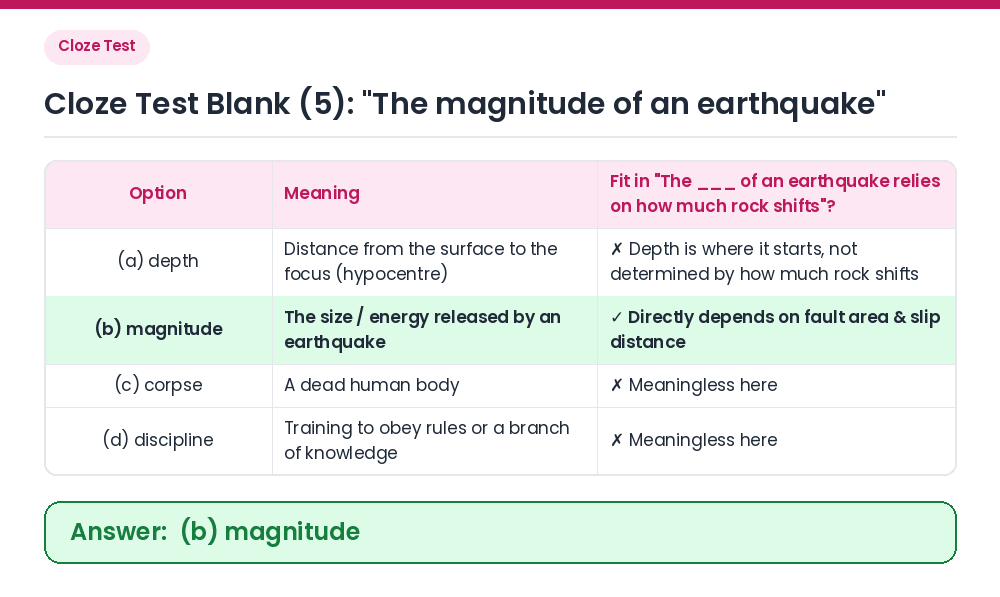
Answer: (B) magnitude
Analyze blank 5: 'The (5)_________ of an earthquake relies on how much and how far rock cracks and shifts.' Scientific and contextual meaning: In seismology, the 'magnitude' (size/strength) of an earthquake is a measure of the energy released, which is directly proportional to the area of the fault rupture ('how much rock cracks') and the displacement along the fault ('how far rock shifts'). Eliminate other options: 'depth' is the focal depth below the surface; 'corpse' (dead body) and 'discipline' are completely unrelated. Correct Answer: (b) magnitude