SSC CGL – Combined Graduate Level Examination · Question 44
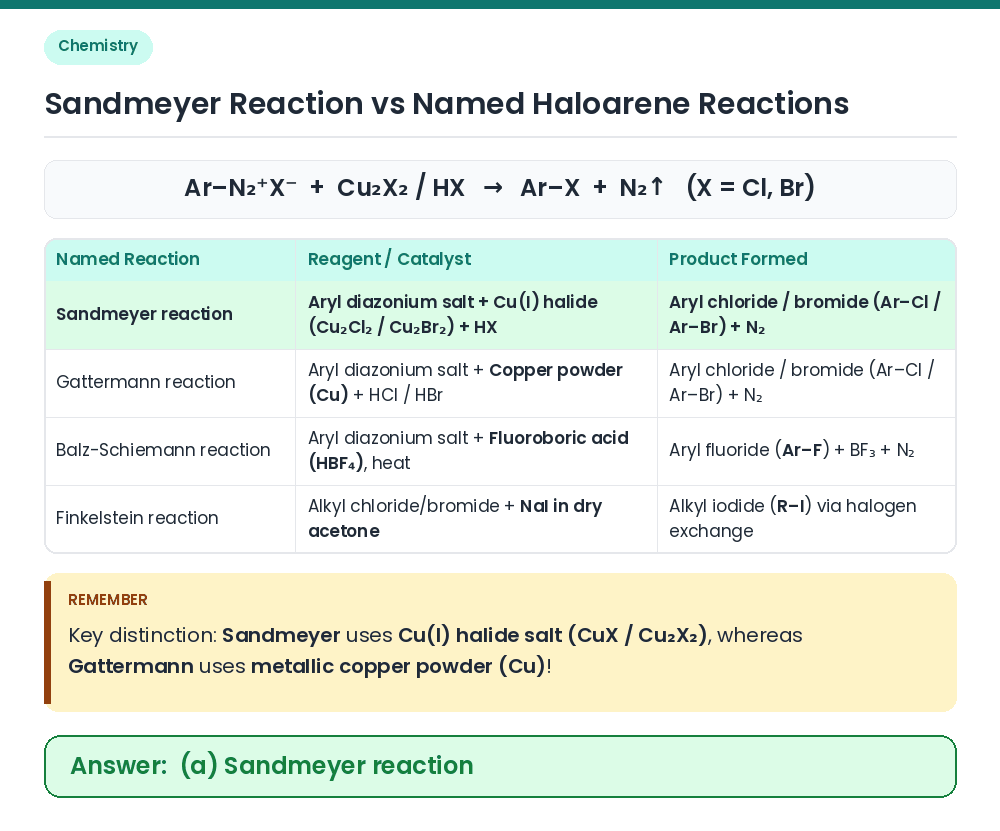
An organic reaction used to convert an aryl diazonium salt into an aryl halide using a copper(I) halide catalyst is called:
Show answer & explanationShow explanation
Answer: (A) Sandmeyer reaction
• Sandmeyer reaction (discovered by Traugott Sandmeyer in 1884): The chemical reaction in which a freshly prepared aryl diazonium salt (ArN₂⁺X⁻) is treated with cuprous halide / copper(I) halide (Cu₂Cl₂/HCl or Cu₂Br₂/HBr) to yield an aryl halide (ArCl or ArBr) with the release of nitrogen gas. • Gattermann reaction: Uses metallic copper powder (Cu + HCl/HBr) instead of copper(I) halide salt to convert an aryl diazonium salt into an aryl halide. • Balz-Schiemann reaction: Converts an aryl diazonium salt into an aryl fluoride (ArF) by heating with fluoroboric acid (HBF₄). • Finkelstein reaction: A halogen-exchange reaction converting alkyl chlorides/bromides into alkyl iodides using NaI in dry acetone. Correct Answer: (a) Sandmeyer reaction