SSC CHSL – Combined Higher Secondary (10+2) Level Examination · Question 17
According to the passage, which approach is suggested for addressing climate migration? Read the following passage and answer the questions based on it: The growing reality of climate migration poses a deep and vexing challenge to the existing ethical and planning paradigms of global society. As melting polar ice, desertification, and increasingly violent weather patterns render vast regions uninhabitable, millions of people are already being displaced from their homes. This process is creating a new generation of forced migrants who lack any formal legal recognition as “climate refugees.” The central question is no longer whether such displacement will happen, but rather how countries should act together and fairly in response. Addressing this crisis demands a multi-faceted strategy. First, there is a need for new international humanitarian and legal protocols that formally recognize and protect climate migrants, moving beyond the current, narrow definition of refugees. Second, effective action requires proactive rather than reactive policy, including the creation of legal and safe resettlement channels, robust humanitarian assistance for displaced populations, and substantial investment in climate resilience for vulnerable communities so that displacement can be prevented wherever possible. This issue also brings into sharp focus the difficult question of burden-sharing. From the perspective of climate justice, the primary responsibility lies with the industrialised world. These nations have historically been the largest per-capita producers of greenhouse gases, directly contributing to the magnitude of the climate crisis. Their economic prosperity was largely built on carbon-polluting industries, the very forces that now threaten the survival of least-developed countries that have contributed minimally to the problem. Consequently, an ethical and equitable response requires industrialised nations to take the lead by providing financial and logistical assistance, supporting adaptation projects in developing countries, and ensuring adequate resources for the resettlement and integration of climate migrants. Ultimately, the international community must recognize that responsibility for climate change is unequally shared, and any fair solution must involve those most responsible taking initiative to reduce its most severe humanitarian consequences.
Show answer & explanationShow explanation
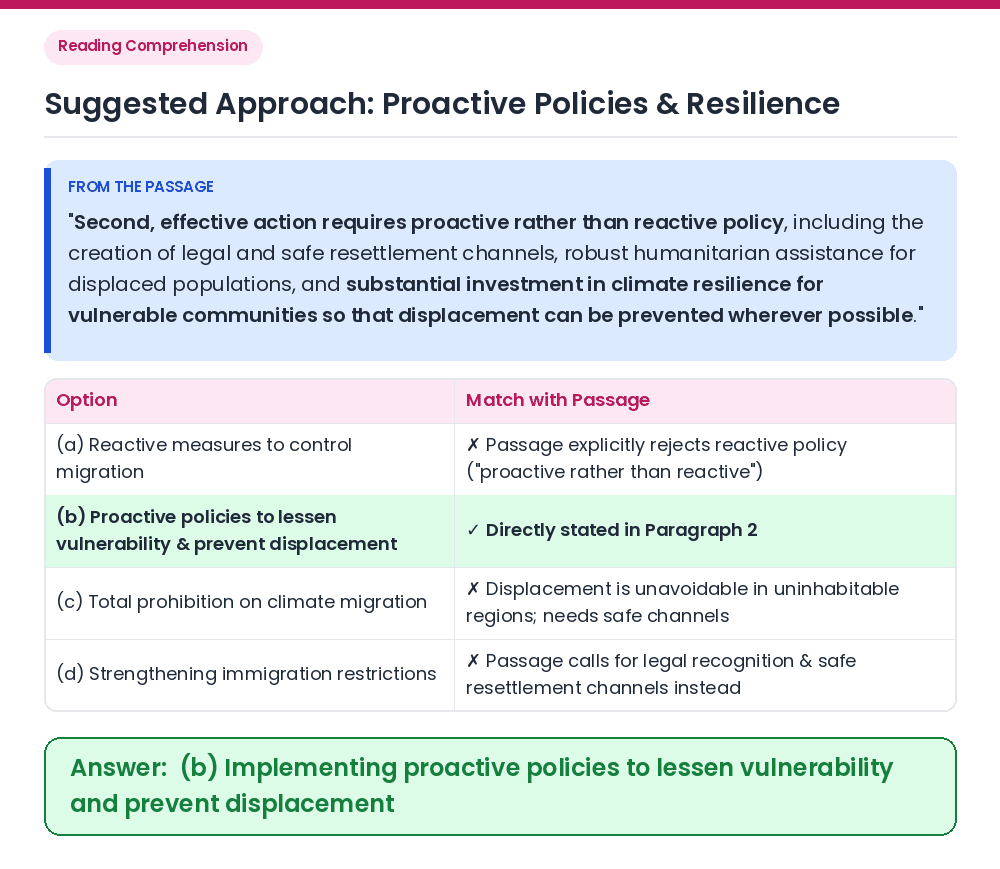
Answer: (B) Implementing proactive policies to lessen vulnerability and prevent displacement
• Evidence in Paragraph 2: 'Second, effective action requires proactive rather than reactive policy, including the creation of legal and safe resettlement channels, robust humanitarian assistance for displaced populations, and substantial investment in climate resilience for vulnerable communities so that displacement can be prevented wherever possible.' • Why (b) is Correct: It accurately summarizes the proactive approach—investing in climate resilience for vulnerable communities to prevent displacement where possible, alongside legal resettlement and aid. • Why Others Are Wrong: (a) promotes reactive measures, which the passage rejects; (c) and (d) advocate bans/restrictions, contrary to the passage's call for safe resettlement channels. Correct Answer: (b) Implementing proactive policies to lessen vulnerability and prevent displacement