MPPSC – State Service Examination · Question 73
The doctrine of 'basic structure' in the context of Indian Constitution was propounded in which of the following cases for the first time?
Show answer & explanationShow explanation
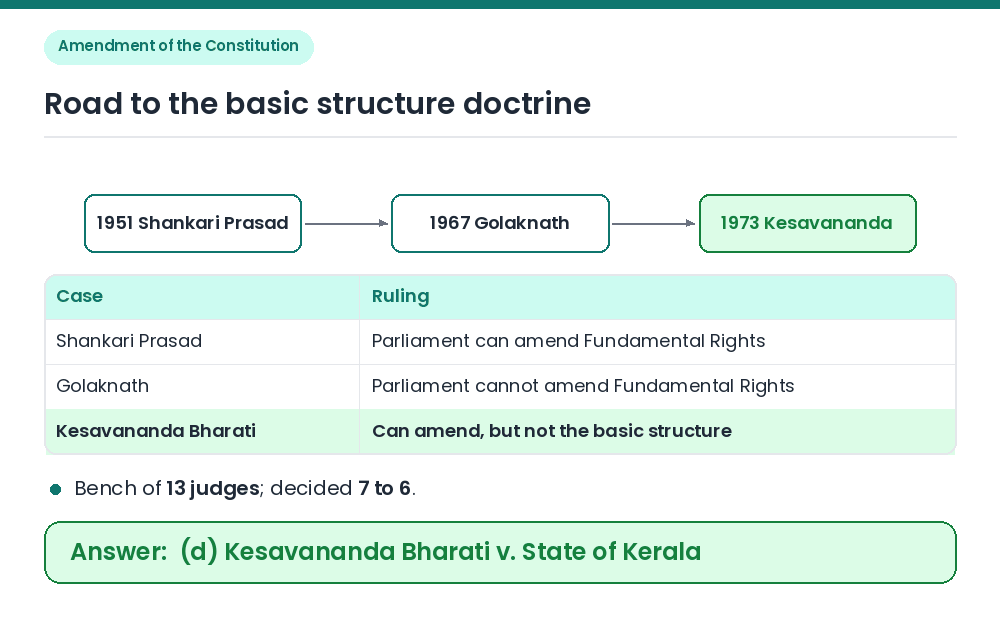
Answer: (D) Kesavananda Bharati v. State of Kerala
The basic structure doctrine was first laid down in Kesavananda Bharati v. State of Kerala (1973). A bench of 13 judges, the largest ever, held by 7 to 6 that Parliament can amend any part of the Constitution but cannot destroy its basic structure. Basic structure means the core features, such as the supremacy of the Constitution, democracy, secularism, federalism and judicial review. (a) Shankari Prasad (1951) held that Parliament can amend even the Fundamental Rights. (b) Champakam Dorairajan (1951) was about caste-based reservation in college seats. (c) Golaknath (1967) held that Parliament cannot amend the Fundamental Rights at all. Related Facts: • The judgment was given on 24 April 1973. • Indira Gandhi v. Raj Narain (1975) was the first case in which the doctrine was applied to strike down an amendment. • Minerva Mills (1980) added that the limited amending power is itself part of the basic structure. Correct Answer: (d) Kesavananda Bharati v. State of Kerala