Civil Services Examination · Question 5
Consider the table given below providing some details of the results of the election to the Karnataka State Legislative Assembly held in December, 1994:
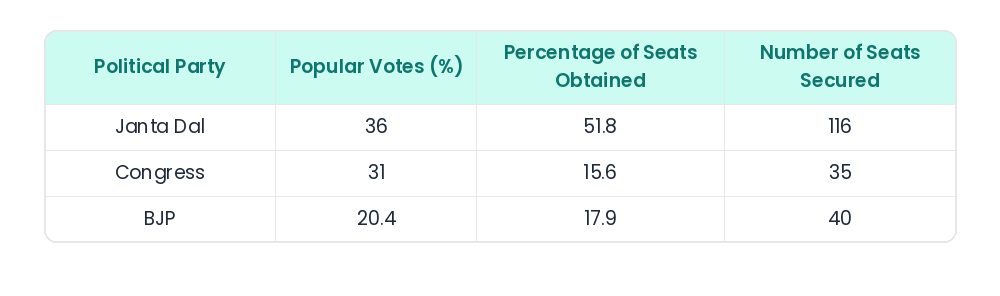
Political Party — Popular Votes (%) — Seats Secured Janta Dal — 36 — 116 Congress — 31 — 35 BJP — 20.4 — 40 In terms of electoral analysis, the voter seat distortion is to be explained as the result of the adoption of the
Show answer & explanationShow explanation
Answer: (C) First-past-the-post system
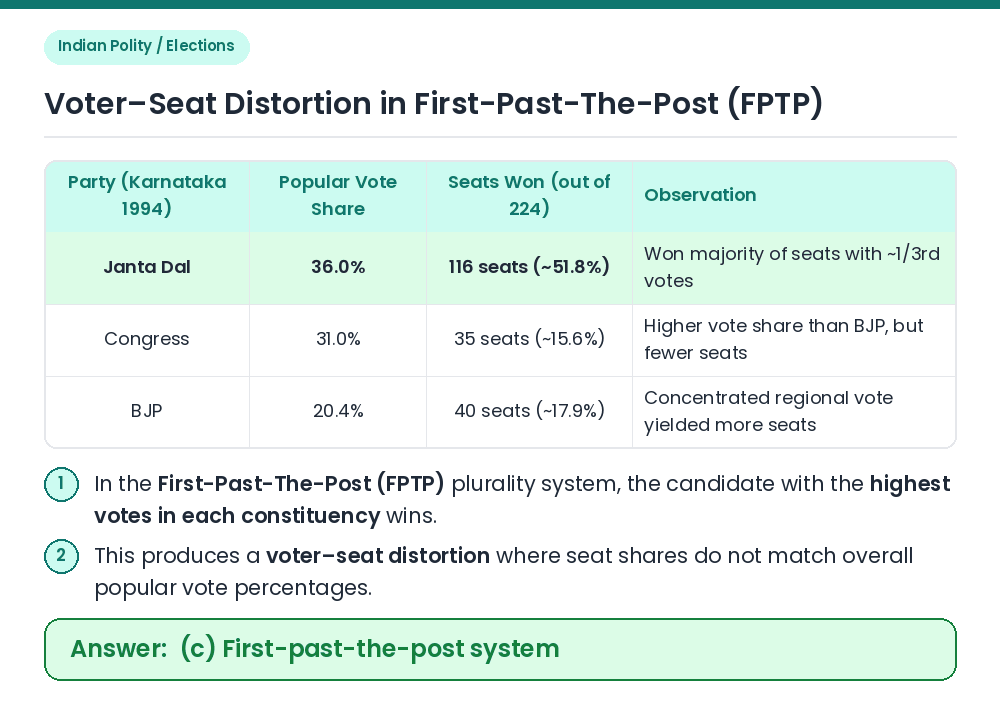
Given Data: In the December 1994 Karnataka Assembly election, Janta Dal won 116 seats with 36% votes, whereas Congress won only 35 seats with 31% votes and BJP won 40 seats with 20.4% votes. Electoral Principle: India uses the First-Past-The-Post (FPTP) system (simple plurality in single-member constituencies) for Lok Sabha and State Legislative Assembly elections. Cause of Distortion: Under FPTP, a party needs only a simple plurality in individual constituencies to win seats, causing large disproportionality between statewide vote share and seat share. Result: The voter-seat distortion is explained by the adoption of the First-past-the-post system. Related Facts: • The Hare system (Single Transferable Vote) is a proportional representation method used in India for Rajya Sabha and Presidential elections. Correct Answer: (c) First-past-the-post system