Civil Services Examination · Question 46
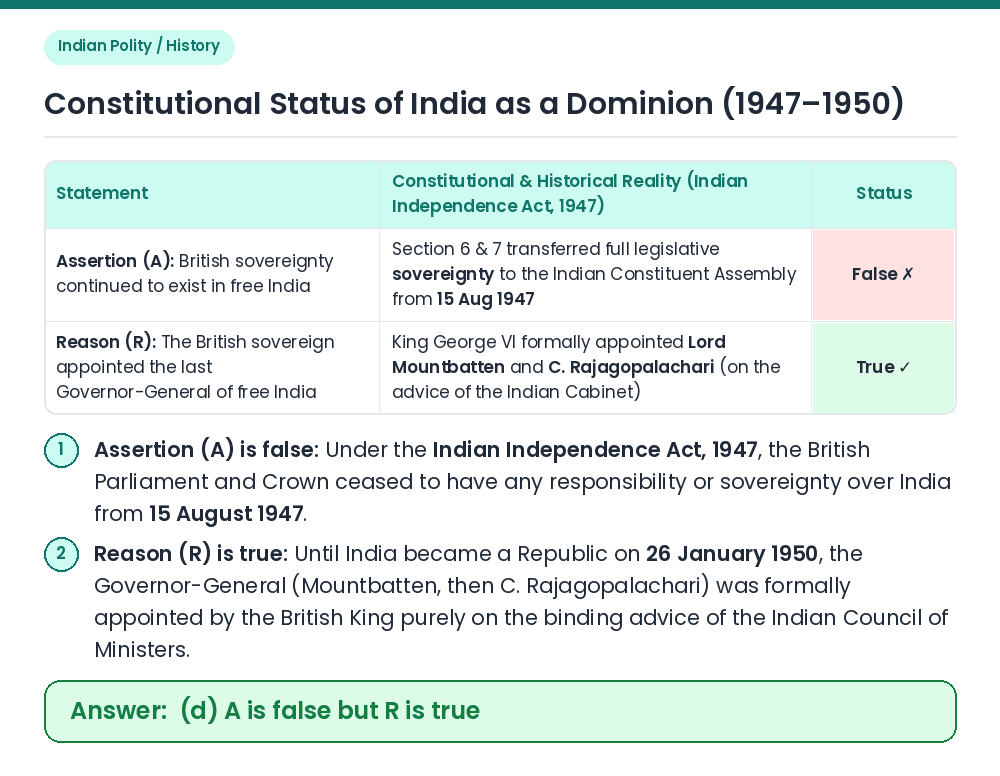
Assertion (A): The British sovereignty continued to exist in free India. Reason (R): The British sovereign appointed the last Governor General of free India. In the context of the above two statements, which one of the following is correct?
Show answer & explanationShow explanation
Answer: (D) A is false but R is true
Concept: Distinguish between substantive political/legislative sovereignty and the titular role of the Crown during India's transitional Dominion phase (15 August 1947 to 26 January 1950). Evaluate Assertion A: ⇒ Under the Indian Independence Act, 1947, British sovereignty over India ended completely on 15 August 1947, and the Constituent Assembly of India became a fully sovereign legislature capable of repealing any British law — so A is false. Evaluate Reason R: ⇒ During the Dominion period (before the office of President was created on 26 January 1950), the last Governor-General of free India (C. Rajagopalachari, 1948–50) was formally appointed by the British monarch (King George VI) on the advice of the Indian Prime Minister and Cabinet — so R is true. Result: A is false but R is true. Related Facts: • Transition to Republic (26 January 1950): On 26 January 1950, the office of Governor-General was abolished and Dr. Rajendra Prasad took oath as the first President of the Republic of India. Correct Answer: (d) A is false but R is true