Civil Services Examination · Question 63
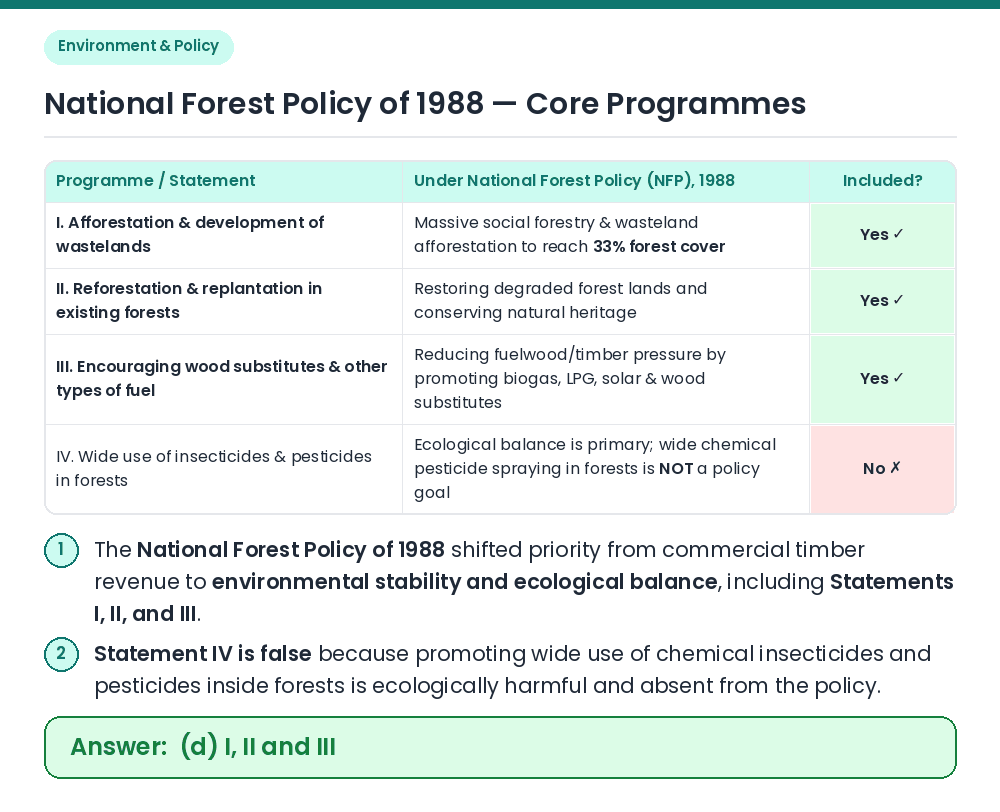
Consider the following programmes: I. Afforestation and development of wastelands. II. Reforestation and replantation in existing forests. III. Encouraging the wood substitutes and supplying other types of fuel. IV. Promotion of wide use of insecticides and pesticides to restrict the loss of forest area from degradation caused by pests and insects. The National Forest Policy of 1988 includes
Show answer & explanationShow explanation
Answer: (D) I, II and III
Concept: Examine the core objectives and strategy of India's National Forest Policy (NFP) of December 1988. Evaluate I, II & III: ⇒ Section 4 of the NFP 1988 explicitly mandates: (I) increasing tree cover rapidly through massive afforestation and social forestry on all denuded and degraded wastelands; (II) reforestation and replantation in existing degraded forests; and (III) substitution of wood (in railway sleepers, construction, furniture, packaging) and supply of alternative domestic fuels to relieve pressure on forests. Eliminate IV: ⇒ Promoting wide use of chemical insecticides and pesticides in natural forest ecosystems threatens biodiversity and was never part of the 1988 policy. Result: The National Forest Policy of 1988 includes I, II and III. Related Facts: • Forest Cover Target (NFP 1988): Stipulates that a minimum of one-third (33%) of the total land area of the country should be under forest or tree cover (and two-thirds or 66% in hills and mountainous regions). • Joint Forest Management (JFM, 1990): Evolved directly out of the 1988 National Forest Policy to involve local village communities and tribals in forest protection. Correct Answer: (d) I, II and III