Civil Services Examination · Question 142
Seven persons P, Q, R, S, T, U and V participate in and finish all the events of a series of swimming races. There are no ties at the finish of any of the events. V always finishes somewhere ahead of P. P always finishes somewhere ahead of Q. Either R finishes first and T finishes last or S finishes first and U or Q finishes last. If in a particular race V finished fifth, then which one of the following would be true?
Show answer & explanationShow explanation
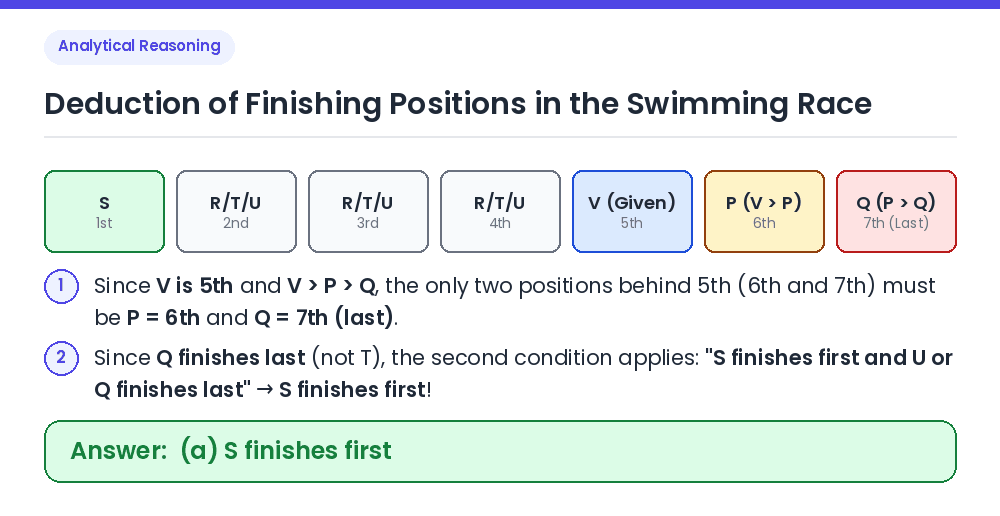
Answer: (A) S finishes first
Given: 7 swimmers (positions 1 to 7, no ties); V is ahead of P, and P is ahead of Q (V > P > Q). In this race, V finished 5th. Determining 6th and 7th Places: • Since V finished 5th and both P and Q must finish behind V in the order P > Q, the only two remaining slots (6th and 7th) are filled by P = 6th and Q = 7th (last). Applying the Either-Or Rule: • Rule: Either [R is 1st and T is last] OR [S is 1st and U or Q is last]. • Since Q is last (7th), T cannot be last ⇒ the second clause holds, so S finishes first. Result: S finishes first. Correct Answer: (a) S finishes first