Civil Services Examination · Question 17
The sum of which of the following constitutes Broad Money in India? I. Currency with the Public II. Demand deposits with banks III. Time deposits with banks IV. Other deposits with RBI Choose the correct answer using the codes given below:
Show answer & explanationShow explanation
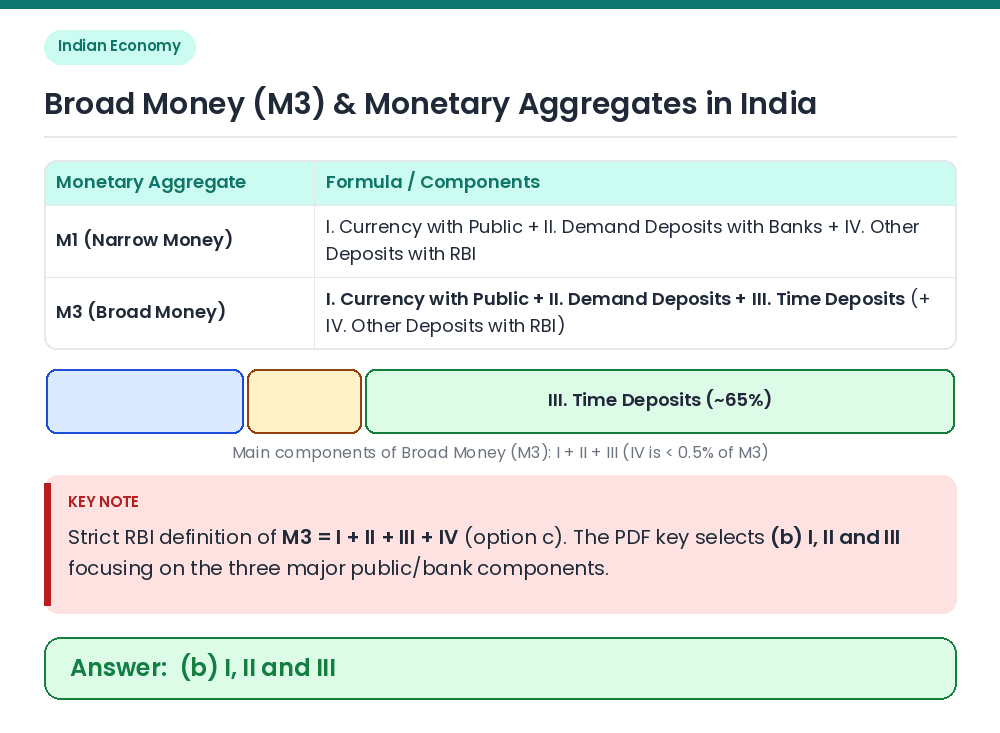
Answer: (B) I, II and III
Concept: The Reserve Bank of India (RBI) measures money supply using narrow money (M1) and broad money (M3). Component Breakdown: • Narrow Money (M1) = Currency with the Public (I) + Demand deposits with banks (II) + Other deposits with RBI (IV). • Broad Money (M3) = M1 + Time deposits with banks (III) ⇒ I + II + III (+ IV). Result: Focusing on the three principal public/commercial-bank components (since 'Other deposits with RBI' is negligible at <0.5%), the PDF key selects (b) I, II and III. Related Facts: • Note on Official RBI Definition: Strictly by RBI's statutory formula, M3 = Currency with the Public + Demand Deposits + Time Deposits + Other Deposits with RBI, making (c) I, II, III and IV the exact complete definition. • Money Multiplier: Defined as the ratio of Broad Money (M3) to Reserve/High-Powered Money (M0). Correct Answer: (b) I, II and III