Civil Services Examination · Question 140
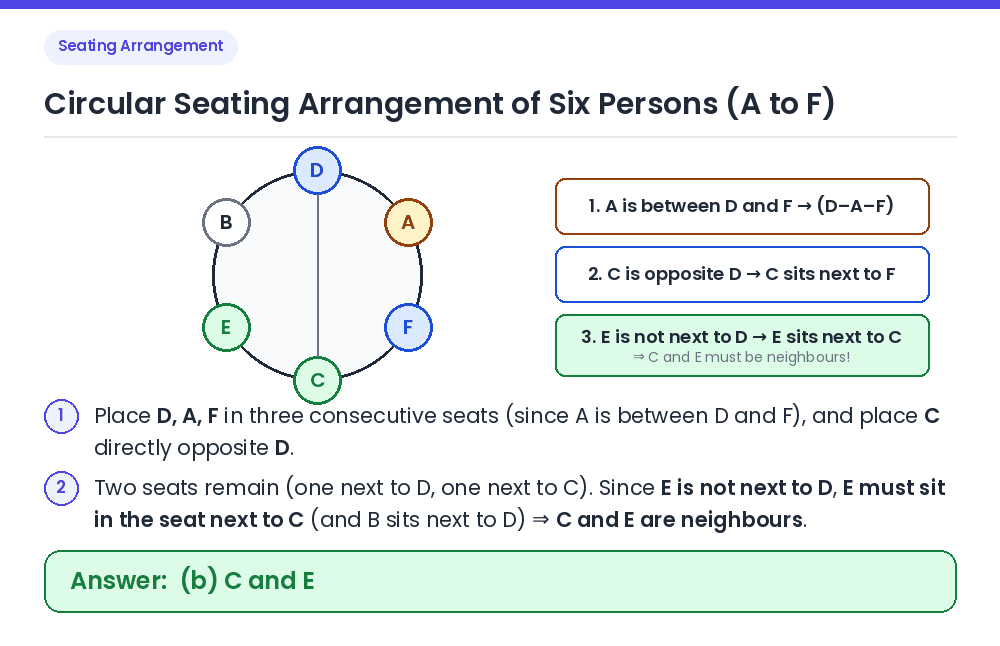
A, B, C, D, E and F, not necessarily in that order are sitting on six chairs regularly placed around a round table. It is observed that A is between D and F, C is opposite D, and D and E are not on neighbouring chairs. Which one of the following pairs must be sitting on neighbouring chairs?
Show answer & explanationShow explanation
Answer: (B) C and E
Given / Concept: Number the 6 equally spaced chairs around the circle clockwise as 1, 2, 3, 4, 5, and 6 (so opposite pairs are 1–4, 2–5, and 3–6). Fix D, A, F and C: Since A sits between D and F, let D = seat 1, A = seat 2, and F = seat 3. Since C sits opposite D (seat 1), C must occupy seat 4. Fix E and B: The remaining two chairs are seat 5 (neighbour of C) and seat 6 (neighbour of D). Since D and E are NOT on neighbouring chairs, E cannot sit at seat 6 ⇒ E must sit at seat 5 (next to C) and B must sit at seat 6 (next to D). Result: The circular order is D(1)–A(2)–F(3)–C(4)–E(5)–B(6), so C and E must be sitting on neighbouring chairs. Shortcut: Once D–A–F and C (opposite D) are placed, E cannot sit beside D, forcing E to sit beside C. Correct Answer: (b) C and E