Civil Services Examination · Question 35
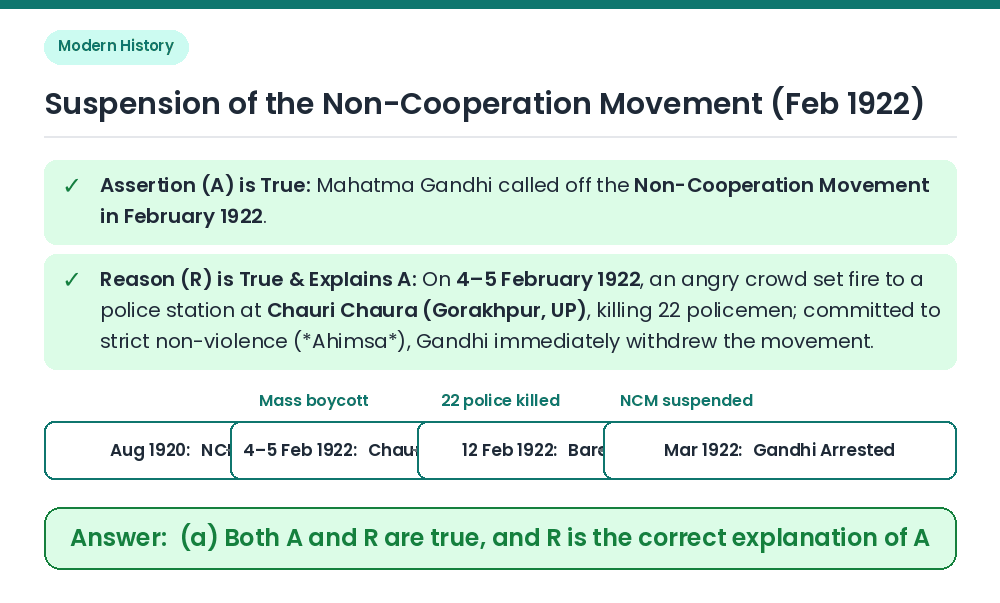
Assertion (A): Gandhi stopped the Non-cooperation Movement in 1922. Reason (R): Violence at Chauri-Chaura led him to stop the movement.
Show answer & explanationShow explanation
Answer: (A) Both A and R are true, and R is the correct explanation of A
Given / Concept: The Non-Cooperation Movement (launched on 1 August 1920) was strictly founded on Mahatma Gandhi's principle of non-violent Satyagraha (Ahimsa). Evaluate Assertion A: In February 1922, Mahatma Gandhi abruptly called off the Non-Cooperation Movement ⇒ A is true. Evaluate Reason R & Link: On 4–5 February 1922 at Chauri Chaura in Gorakhpur district (Uttar Pradesh), protesters clashed with police and burned down a police station, killing 22 policemen; shocked by this outbreak of violence, Gandhi convened the Congress Working Committee at Bardoli on 12 February 1922 to suspend the movement ⇒ R is true and directly explains A. Result: Both A and R are true, and R is the correct explanation of A. Related Facts: • Bardoli Resolution (12 Feb 1922): Formally suspended mass civil disobedience and directed Congressmen toward constructive work (spinning khadi, national schools, Hindu–Muslim unity, and abolition of untouchability). • Nationalist Reaction: Leaders like Subhas Chandra Bose, Motilal Nehru, and C.R. Das criticized the sudden withdrawal when popular enthusiasm was at its peak. Correct Answer: (a) Both A and R are true, and R is the correct explanation of A