Civil Services Examination · Question 73
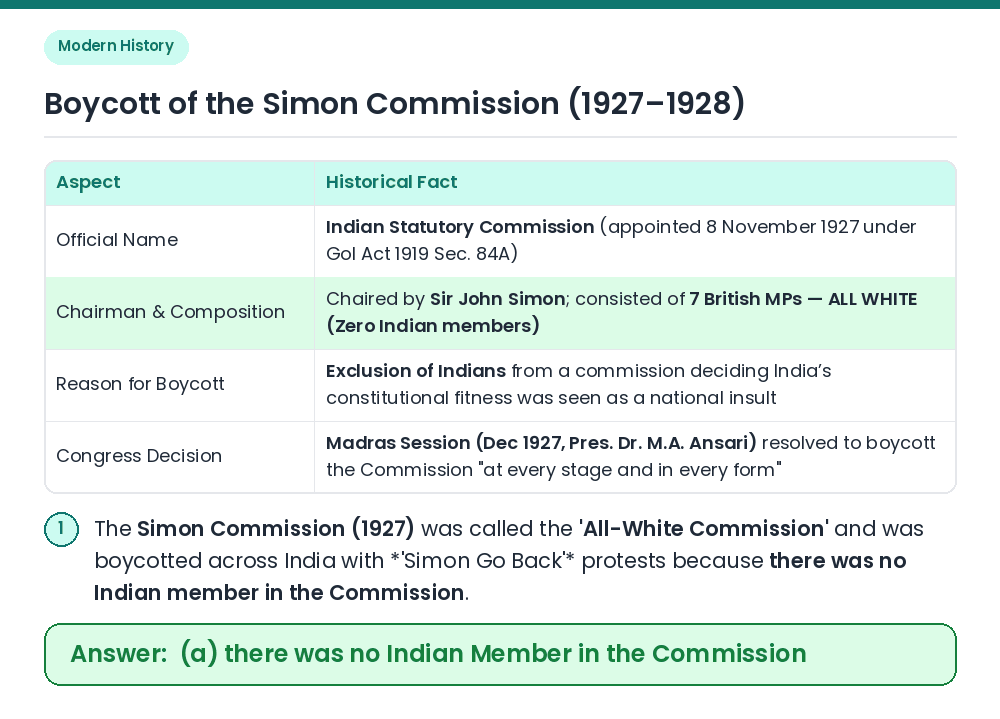
Simon Commission of 1927 was boycotted because:
Show answer & explanationShow explanation
Answer: (A) there was no Indian Member in the Commission
Given / Concept: In November 1927, the British Conservative government (under PM Stanley Baldwin and Secretary of State Lord Birkenhead) appointed the seven-member Indian Statutory Commission chaired by Sir John Simon to review the Government of India Act, 1919. Cause of Outrage: All seven members of the Commission were British parliamentarians ('All-White Commission'), with not a single Indian member included to decide India's constitutional future. All-Party Boycott: Both the Indian National Congress (at its December 1927 Madras session presided over by M.A. Ansari) and the Jinnah faction of the Muslim League, along with the Liberal Federation and Hindu Mahasabha, boycotted the Commission. Result: The Simon Commission was boycotted because there was no Indian member in the Commission. Related Facts: • Martyrdom of Lala Lajpat Rai (1928): On 30 October 1928, while leading a peaceful anti-Simon demonstration in Lahore, Lala Lajpat Rai ('Sher-e-Punjab') was brutally lathi-charged on the orders of Superintendent James A. Scott and succumbed to his injuries on 17 November 1928. • Nehru Report (1928): Answering Lord Birkenhead's challenge to frame a constitution agreed upon by Indians, an All-Parties Conference chaired by Motilal Nehru drafted the Nehru Report in August 1928. Correct Answer: (a) there was no Indian Member in the Commission