Civil Services Examination · Question 91
Which one of the following is the correct sequence of decreasing order of the given currencies in terms of their value in Indian Rupees?
Show answer & explanationShow explanation
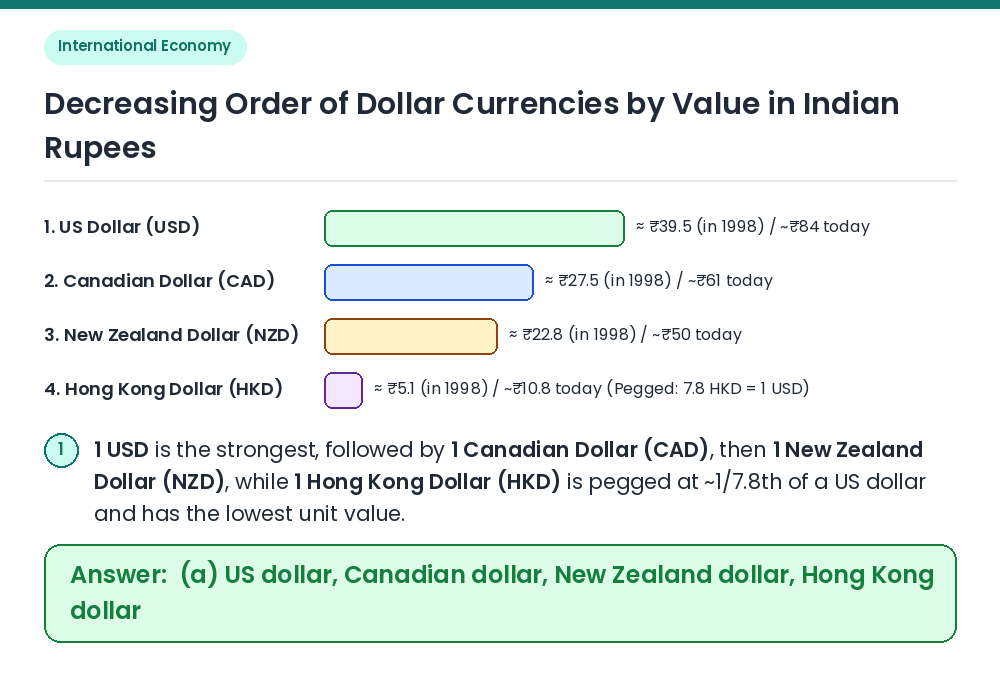
Answer: (A) US dollar, Canadian dollar, New Zealand dollar, Hong Kong dollar
Given / Concept: Compare the exchange value of one unit of each currency (USD, CAD, NZD, HKD) expressed in Indian Rupees (INR). Compare USD and HKD: The Hong Kong dollar (HKD) has been pegged to the US dollar since 1983 at approximately 7.80 HKD = 1 USD, meaning 1 HKD is worth only about 1/7.8th of a US dollar (making HKD by far the smallest of the four and eliminating c and d). Compare CAD and NZD: Both in 1997–98 (1 USD ≈ ₹39.5, 1 CAD ≈ ₹27.5, 1 NZD ≈ ₹22.8, 1 HKD ≈ ₹5.1) and today, 1 Canadian dollar has a higher Rupee value than 1 New Zealand dollar ⇒ USD > CAD > NZD > HKD. Result: The decreasing order of value in Indian Rupees is US dollar, Canadian dollar, New Zealand dollar, Hong Kong dollar. Shortcut: HKD is pegged at ~7.8 per USD (so HKD is last), and CAD is worth more than NZD ⇒ (a). Correct Answer: (a) US dollar, Canadian dollar, New Zealand dollar, Hong Kong dollar