Civil Services Examination · Question 25
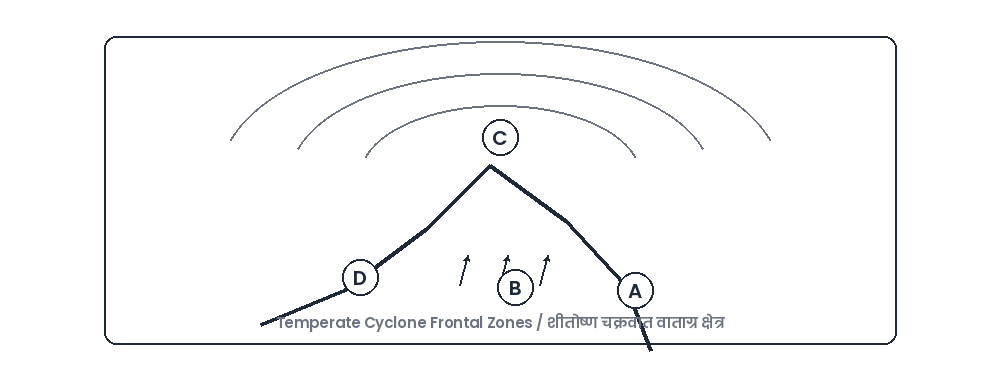
Which one of the areas marked as A, B, C and D in the given figure of the cyclone, witnesses heavy torrential short duration rainfall accompanied by thunderstorms?
Show answer & explanationShow explanation
Answer: (C) C
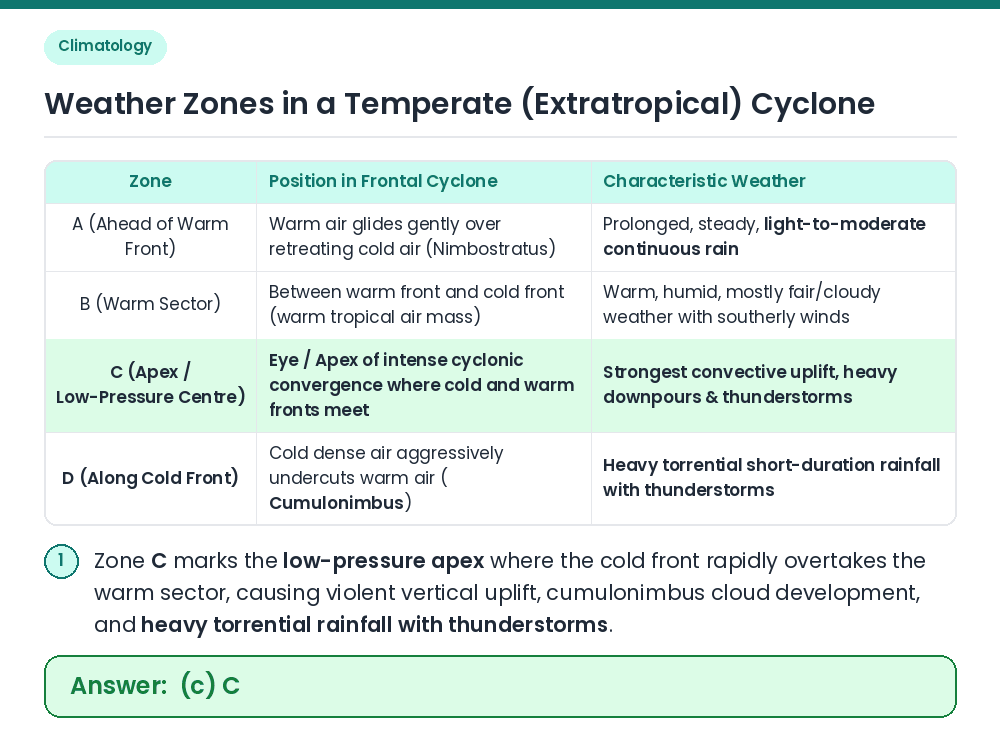
Concept: A temperate (extratropical) cyclone has a warm front on its eastern side (A), a warm sector in the middle (B), a low-pressure apex/occlusion at the top (C), and a cold front on its western/rear side (D). Cold Front vs Warm Front Weather: Along the cold front (D), dense cold air rapidly undercuts warm moist air along a steep slope, forming towering cumulonimbus clouds that produce heavy, torrential, short-duration downpours accompanied by thunder and lightning. Ahead of the warm front (A), gentle uplift produces steady, prolonged drizzle/rain. Apex Convergence at C: At the central low-pressure apex C (and along the advancing cold front D), intense convergence and rapid uplift of warm, moist air generate cumulonimbus clouds that produce heavy torrential short-duration rainfall accompanied by thunderstorms. Result: Area C witnesses heavy torrential short-duration rainfall accompanied by thunderstorms. Related Facts: • Bjerknes Polar Front Theory (1918): Vilhelm and Jacob Bjerknes formulated the frontal wave model of mid-latitude cyclones. • Slope Ratio: A cold front is roughly twice as steep (~1:50 to 1:100) as a warm front (~1:100 to 1:200), explaining its violent convective uplift. Correct Answer: (c) C