Civil Services Examination · Question 62
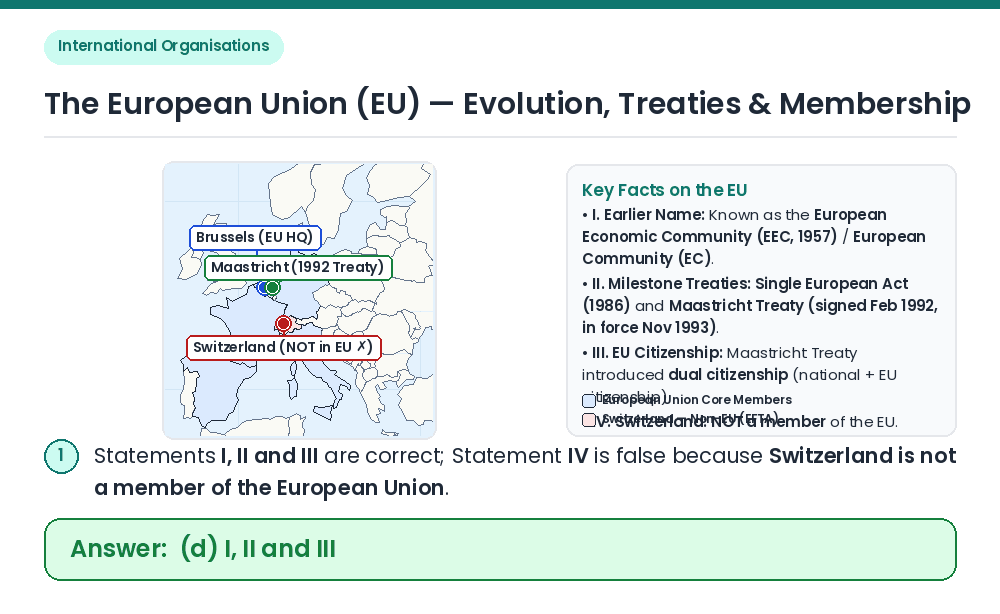
Consider the following statements about the European Union: I. The European Union was known earlier as the European Community. II. The Single European Act (1986) and the Maastricht Treaty were milestones in its formation. III. Citizens of European Union countries enjoy dual citizenship. IV. Switzerland is a member of the European Union. Which of the above statements are correct?
Show answer & explanationShow explanation
Answer: (D) I, II and III
Concept: Verify the institutional evolution, citizenship rules, and membership of the European Union (EU). Evaluate Statement IV: Switzerland has consistently chosen to remain outside the European Union (belonging instead to EFTA). Because Statement IV is false, options (a) and (c) are immediately eliminated. Evaluate I, II, and III: The EU evolved from the European Community (I); the Single European Act (1986) and the Maastricht Treaty (1992/1993) were foundational milestones (II); and the Maastricht Treaty established EU citizenship alongside national citizenship (III). Result: Statements I, II and III are correct. Related Facts: • Treaty of Rome (1957): Six founding members (Belgium, France, Italy, Luxembourg, Netherlands, and West Germany) created the EEC. • Euro Currency (1 January 1999): The Euro was launched as an electronic/accounting currency in 11 EU member states on 1 January 1999. Correct Answer: (d) I, II and III