Civil Services Examination · Question 104
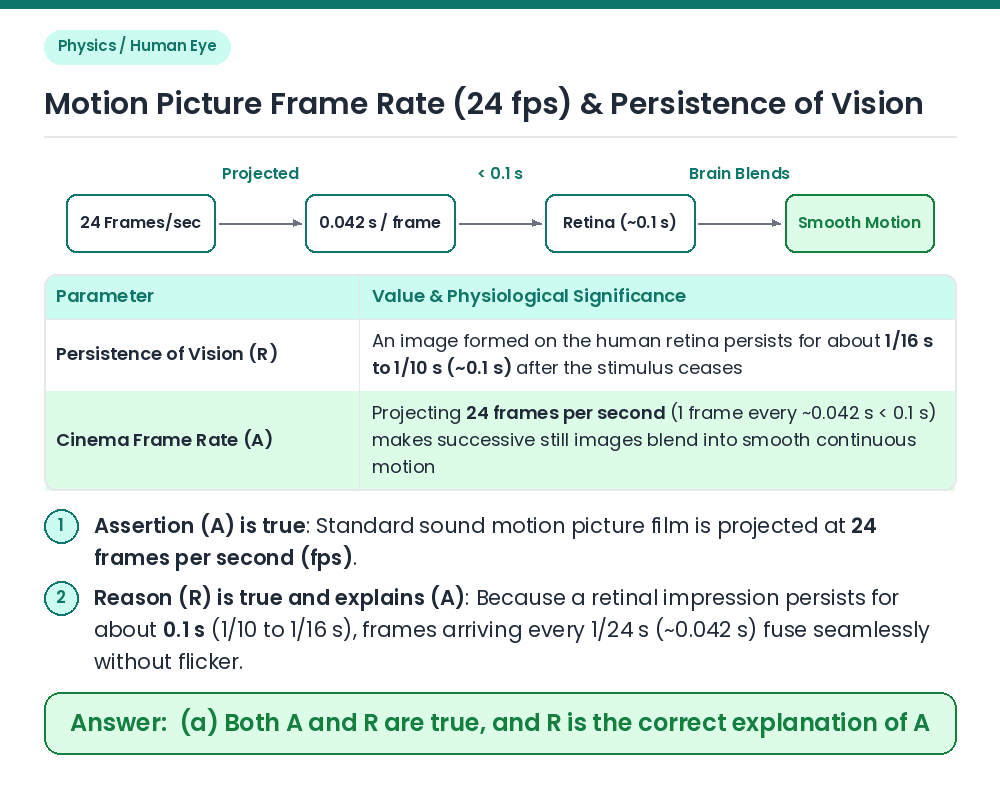
Assertion (A): In a motion picture, usually 24 frames are projected every second over the whole length of the film. Reason (R): An image formed on the retina of eye persists for about 0.1 s after the removal of stimulus.
Show answer & explanationShow explanation
Answer: (A) Both A and R are true, and R is the correct explanation of A
Concept: Cinematography relies on the physiological phenomenon of 'persistence of vision' (along with beta movement / phi phenomenon in the visual cortex). Evaluate A & R: In standard motion pictures, 24 still frames are projected per second (i.e., a new frame every 0.0417 s) (A is true) ⇒ The visual impression of an image on the human retina persists for roughly 1/16 to 1/10 of a second (about 0.1 s) after the light stimulus is removed (R is true). Causal Link & Result: Because the time interval between successive frames (0.042 s) is shorter than the persistence time of the retina (~0.1 s), the eye perceives continuous smooth motion rather than separate still pictures ⇒ Both A and R are true, and R is the correct explanation of A. Related Facts: • Retina Photoreceptors: Rods (responsible for dim/scotopic vision) and Cones (responsible for colour/photopic vision). • Image on Retina: The eye lens forms a real and inverted image on the retina. Correct Answer: (a) Both A and R are true, and R is the correct explanation of A