Civil Services Examination · Question 82
Match List I with List II and select the correct answer using the codes given below the Lists: List I: I. Land allotted to big feudal landlords II. Land allotted to revenue farmers or rent collectors III. Land allotted to each peasant with the right to sublet, mortgage, transfer, gift or sell IV. Revenue settlements made at village level
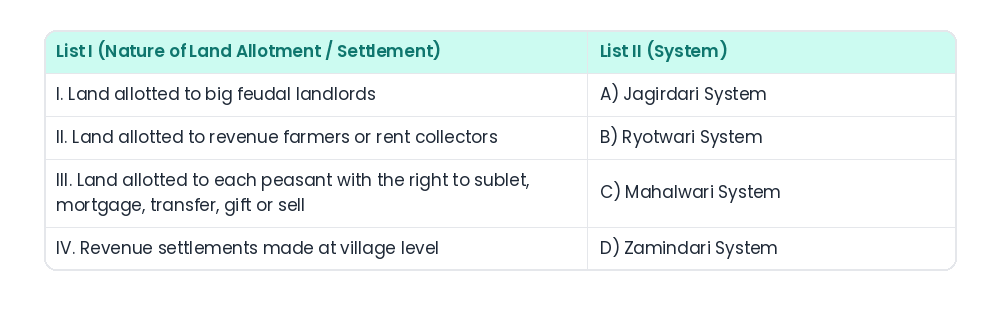
List II: A) Jagirdari System B) Ryotwari System C) Mahalwari System D) Zamindari System Codes:
Show answer & explanationShow explanation
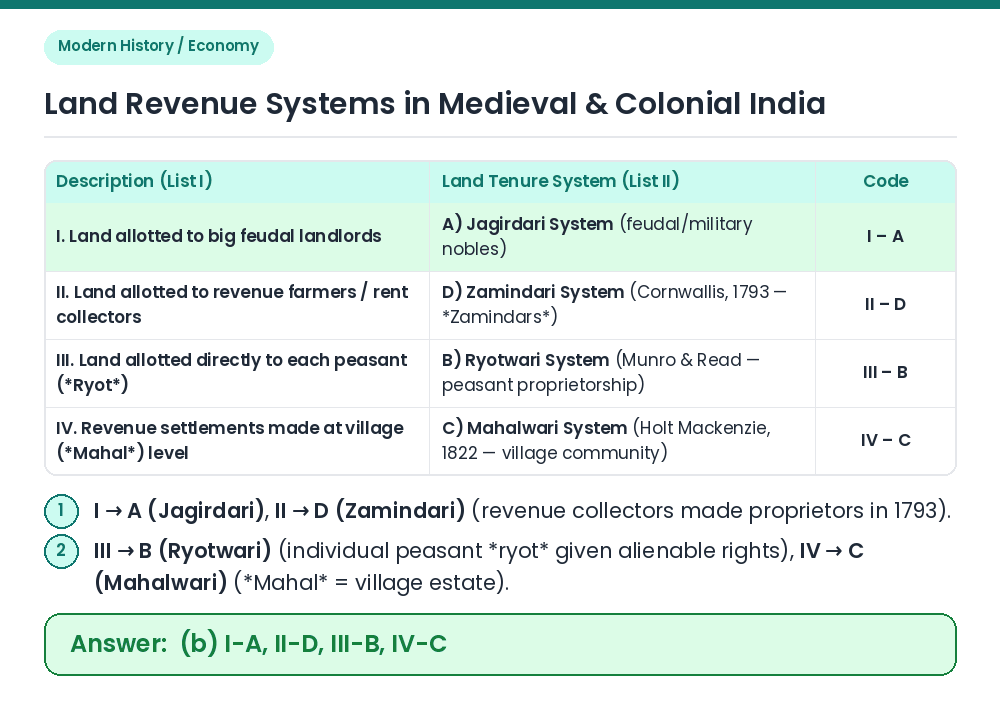
Answer: (B) I-A, II-D, III-B, IV-C
Concept: Distinguish the four major land-tenure systems of medieval and British India by who held the revenue settlement and property rights. Match Systems: I. Land allotted to big feudal landlords/nobles corresponds to the Jagirdari System (A) ⇒ II. Land allotted to revenue farmers/rent collectors corresponds to the Zamindari (Permanent Settlement) System (D) ⇒ III. Land allotted directly to each individual peasant (ryot) with ownership rights to mortgage, transfer, or sell corresponds to the Ryotwari System (B) ⇒ IV. Revenue settlements made collectively at the village (mahal) level corresponds to the Mahalwari System (C). Result: The correct matching code is I-A, II-D, III-B, IV-C. Related Facts: • Coverage in British India: Zamindari covered ~19% of area (Bengal, Bihar, Odisha), Ryotwari covered ~51% (Madras, Bombay, Assam), and Mahalwari covered ~30% (NW Provinces, Punjab, Central Provinces). • Key Architects: Lord Cornwallis (Permanent Settlement, 1793), Thomas Munro & Alexander Read (Ryotwari, 1820), and Holt Mackenzie & R. M. Bird (Mahalwari, 1822/1833). Correct Answer: (b) I-A, II-D, III-B, IV-C