Civil Services Examination · Question 93
Assertion (A): The basic weakness of the early nationalist movement lay in its narrow social base. Reason (R): It fought for the narrow interests of the social groups which joined it.
Show answer & explanationShow explanation
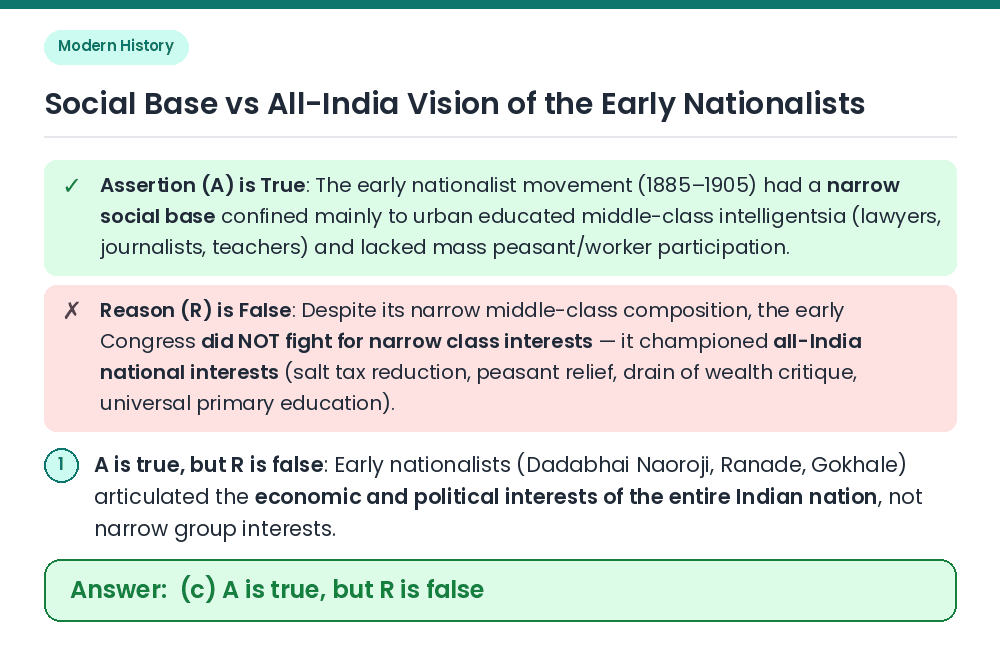
Answer: (C) A is true, but R is false
Concept: Assess the social character and ideological programme of the Moderate phase (1885–1905) of the Indian National Congress. Evaluate A: Assertion (A) is true because the early nationalist leadership was drawn predominantly from the urban educated middle class (lawyers, doctors, journalists, teachers) and had not yet mobilized the broad masses of peasants and workers. Evaluate R & Result: Reason (R) is false because, as historian Bipan Chandra famously showed, the early nationalists did not fight for the narrow self-interest of the middle class or bourgeoisie; instead, they formulated an all-India anti-colonial economic critique (opposing the Salt Tax, high land revenue, and the Drain of Wealth) representing the entire nation ⇒ A is true, but R is false. Related Facts: • Economic Critique of Colonialism: Propounded by Dadabhai Naoroji, R. C. Dutt ('The Economic History of India'), and G. V. Joshi. • Key Moderate Demands: Abolition of the Salt Tax, reduction of land revenue, cuts in military expenditure, and simultaneous ICS examinations in India and England. Correct Answer: (c) A is true, but R is false