Civil Services Examination · Question 30
With reference to Sufism in Indian history, consider the following statements: 1. Shaikh Ahmad Sarhandi was a contemporary of Ibrahim Lodi 2. Shaikh Nasiruddin Chirag-i-Dehlavi was a disciple of Shaikh Nizamuddin Auliya 3. Aurangzeb was contemporary of Shaikh Salim Chisti 4. The Qadiri order of Sufis was first introduced in India by Shaikh Niamtullah and Makhdum Muhammad Jilani Which of these statements are correct?
Show answer & explanationShow explanation
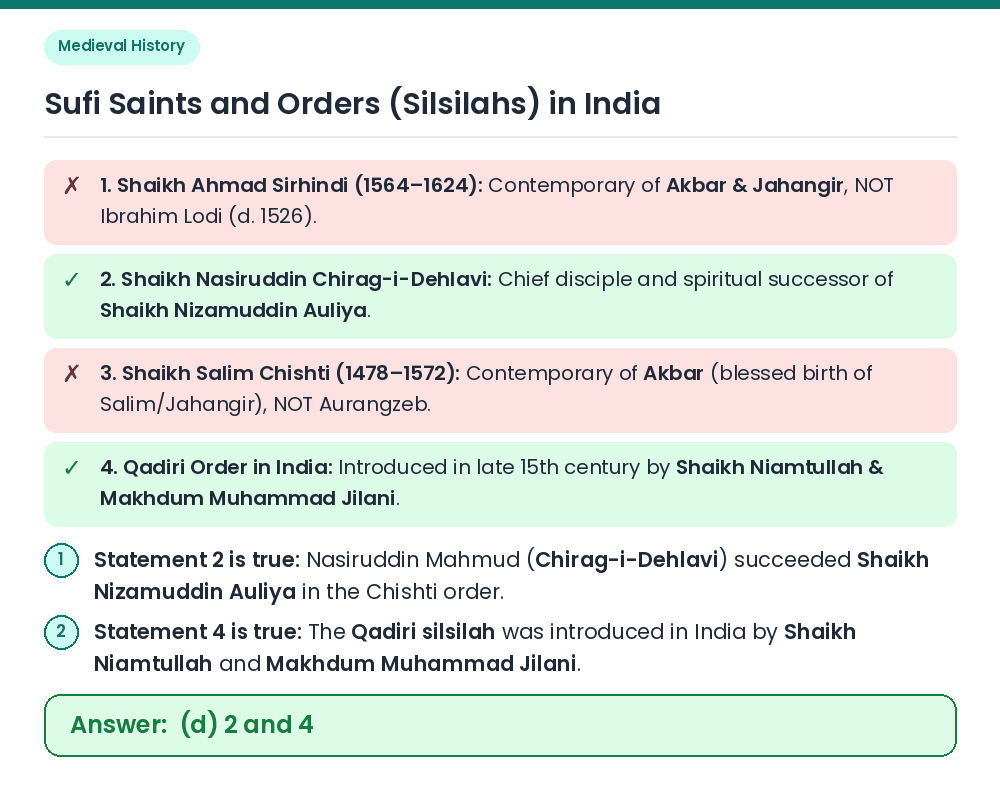
Answer: (D) 2 and 4
Given / Concept: Chronological and spiritual lineage of major Sufi saints and orders (Silsilahs) in medieval India. Checking 1 & 3: Shaikh Ahmad Sirhindi (Mujaddid, 1564–1624) of the Naqshbandi order was a contemporary of Mughal Emperors Akbar and Jahangir, not Ibrahim Lodi (1 is false). Shaikh Salim Chishti (1478–1572) of Fatehpur Sikri was a contemporary of Akbar, not Aurangzeb (3 is false). Checking 2 & 4: Shaikh Nasiruddin Chirag-i-Dehlavi (d. 1356) was the foremost disciple and Khalifah of Shaikh Nizamuddin Auliya (2 is true). The Qadiri order (founded by Abdul Qadir Gilani of Baghdad) was introduced into India in the late 15th century by Syed Mohammad Niamtullah and Makhdum Muhammad Jilani (4 is true). Result: Statements 2 and 4 are correct. Related Facts: • Chishti Lineage: Khwaja Moinuddin Chishti (Ajmer) → Qutbuddin Bakhtiyar Kaki → Baba Farid → Nizamuddin Auliya → Nasiruddin Chirag-i-Dehlavi. • Famous Qadiri Saints: Miyan Mir (who laid the foundation stone of the Golden Temple) and Mullah Shah Badakhshi (mentor of Dara Shikoh). Correct Answer: (d) 2 and 4