Civil Services Examination · Question 105
Assertion (A): In the periodic table of chemical elements, electron affinity is always found to increase from top to bottom in a group. Reason (R): In a group, the atomic radii generally increase from top to bottom.
Show answer & explanationShow explanation
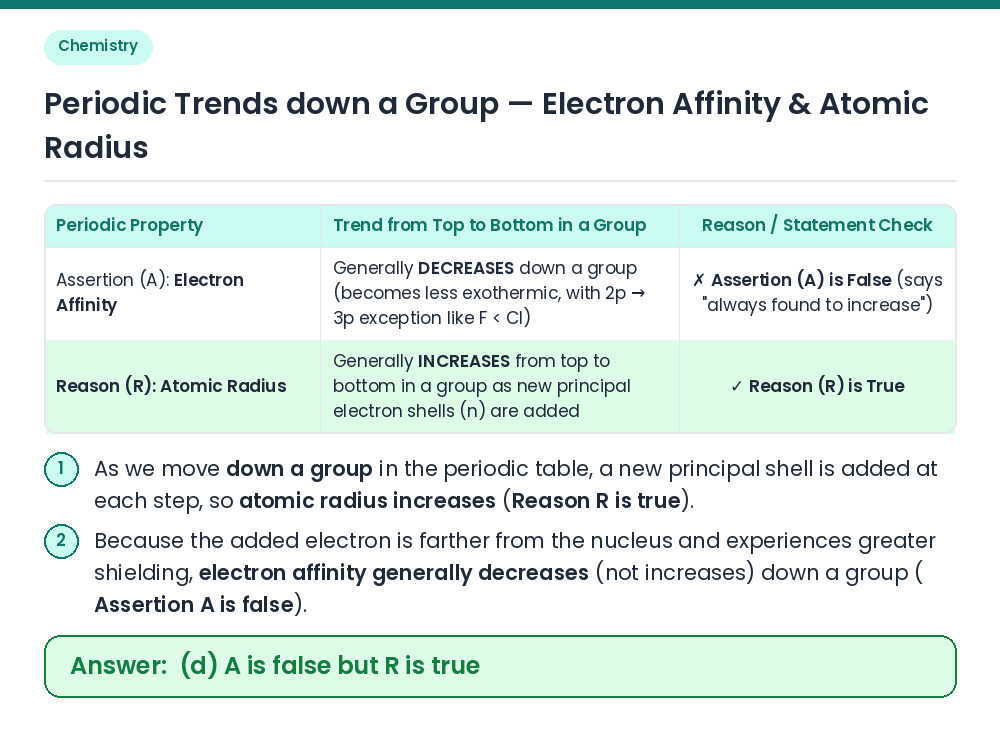
Answer: (D) A is false but R is true
Concept: Recall the periodic trends of atomic radius and electron affinity (electron gain enthalpy) on moving down a group in the periodic table. Evaluate Assertion A: On moving from top to bottom in a group, nuclear attraction on the incoming electron weakens due to larger atomic size and increased shielding, so electron affinity generally decreases down a group (with an exception from Period 2 to Period 3, e.g., Cl > F > Br > I) ⇒ Assertion (A) is false. Evaluate Reason R: In a group, the atomic radius increases from top to bottom because valence electrons enter successively higher principal energy shells (n) ⇒ Reason (R) is true. Result: A is false but R is true. Related Facts: • Highest Electron Affinity Element: Chlorine (Cl) has the highest electron affinity in the periodic table (higher than Fluorine due to severe electron-electron repulsion in Fluorine's compact 2p subshell). Correct Answer: (d) A is false but R is true