Civil Services Examination · Question 118
Which one of following is produced during the formation of photochemical smog?
Show answer & explanationShow explanation
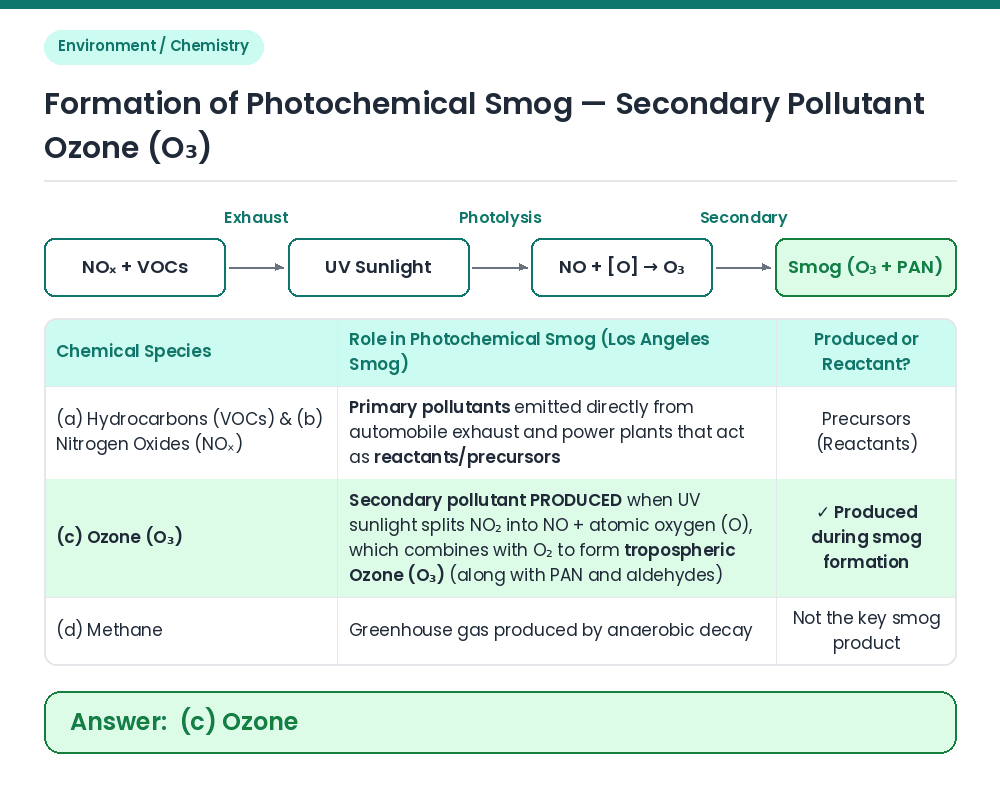
Answer: (C) Ozone
Concept: Distinguish between the primary precursor pollutants and the secondary pollutants produced during the formation of photochemical (oxidising) smog. Trace photochemical reactions: Primary pollutants emitted from vehicle exhaust — Nitrogen Oxides (NOₓ) and volatile Hydrocarbons (VOCs) — react in the presence of strong sunlight (UV radiation): NO₂ + hv → NO + [O], followed by [O] + O₂ → O₃ (Ozone). This tropospheric ozone then reacts with unburnt hydrocarbons to form Peroxyacetyl Nitrate (PAN), acrolein, and formaldehyde. Result: Ozone is produced as a secondary pollutant during the formation of photochemical smog. Related Facts: • Photochemical vs Classical Smog: Photochemical smog (Los Angeles type) occurs in warm, dry, sunny climates and is oxidising in nature (O₃ + PAN + NO₂); Classical smog (London type) occurs in cool, humid climates and is reducing in nature (smoke + fog + SO₂). Correct Answer: (c) Ozone