Civil Services Examination · Question 128
Which one of the following provisions was NOT made in the Charter Act of 1833?
Show answer & explanationShow explanation
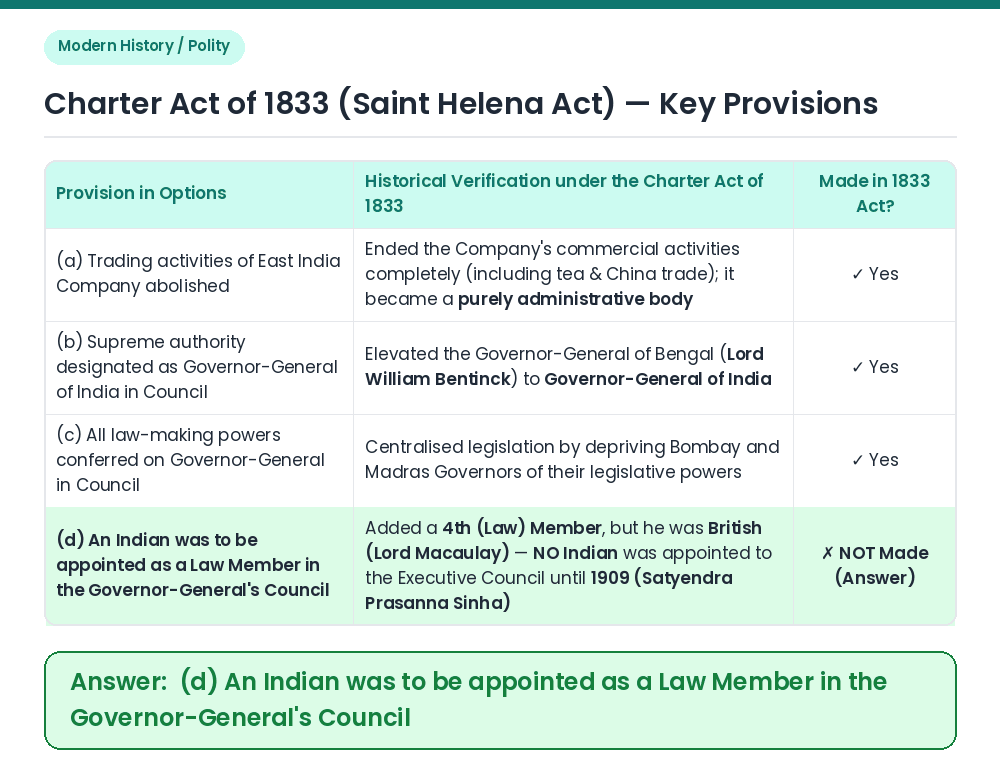
Answer: (D) An Indian was to be appointed as a Law Member in the Governor-General's Council
Concept: Examine the constitutional and administrative provisions of the Charter Act of 1833. Verify Options a, b, c: The Charter Act of 1833 ended all commercial/trading activities of the East India Company (a is true); redesignated the Governor-General of Bengal as the Governor-General of India in Council, with Lord William Bentinck as the first holder (b is true); and centralised all legislative powers in the Governor-General in Council (c is true). Identify Option d as NOT made: While the Charter Act of 1833 added a 4th Member (Law Member) to the Governor-General's Council for legislative purposes, the post went to an Englishman (Lord Macaulay). The first Indian appointed as Law Member of the Viceroy's Executive Council was Satyendra Prasanna Sinha under the Indian Councils Act of 1909 (Morley–Minto Reforms) ⇒ Provision (d) was NOT made in the Charter Act of 1833. Result: Option (d) was NOT made in the Charter Act of 1833. Related Facts: • First Law Commission (1834): Established under the Charter Act of 1833 with Lord Macaulay as its Chairman, which drafted the Indian Penal Code. Correct Answer: (d) An Indian was to be appointed as a Law Member in the Governor-General's Council