Civil Services Examination · Question 141
'A' and 'B' are two fixed points in a field. A cyclist C moves such that ACB is always a right angle. In this context, which one of the following statements is correct?
Show answer & explanationShow explanation
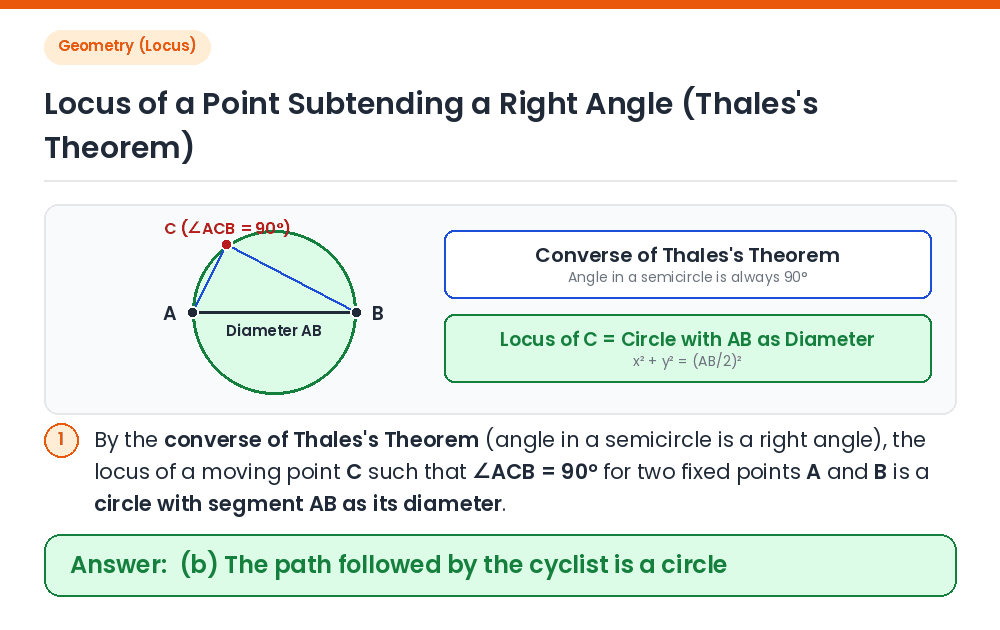
Answer: (B) The path followed by the cyclist is a circle
Given: A and B are two fixed points in a plane, and a moving point C satisfies ∠ACB = 90° at all positions. Apply Converse of Thales's Theorem / Coordinate Geometry: Place A at (−a, 0) and B at (+a, 0), and let C be (x, y). Since AC is perpendicular to BC, (Slope of AC) × (Slope of BC) = −1 ⇒ [y / (x + a)] × [y / (x − a)] = −1 ⇒ x² + y² = a². Identify the locus: The equation x² + y² = a² represents a circle with segment AB as its diameter (excluding the endpoints A and B). Result: The path followed by the cyclist is a circle. Shortcut: 'Angle in a semicircle is a right angle' (Thales's theorem) ⇒ Locus of C with ∠ACB = 90° is a circle with AB as diameter. Correct Answer: (b) The path followed by the cyclist is a circle