Civil Services Examination · Question 19
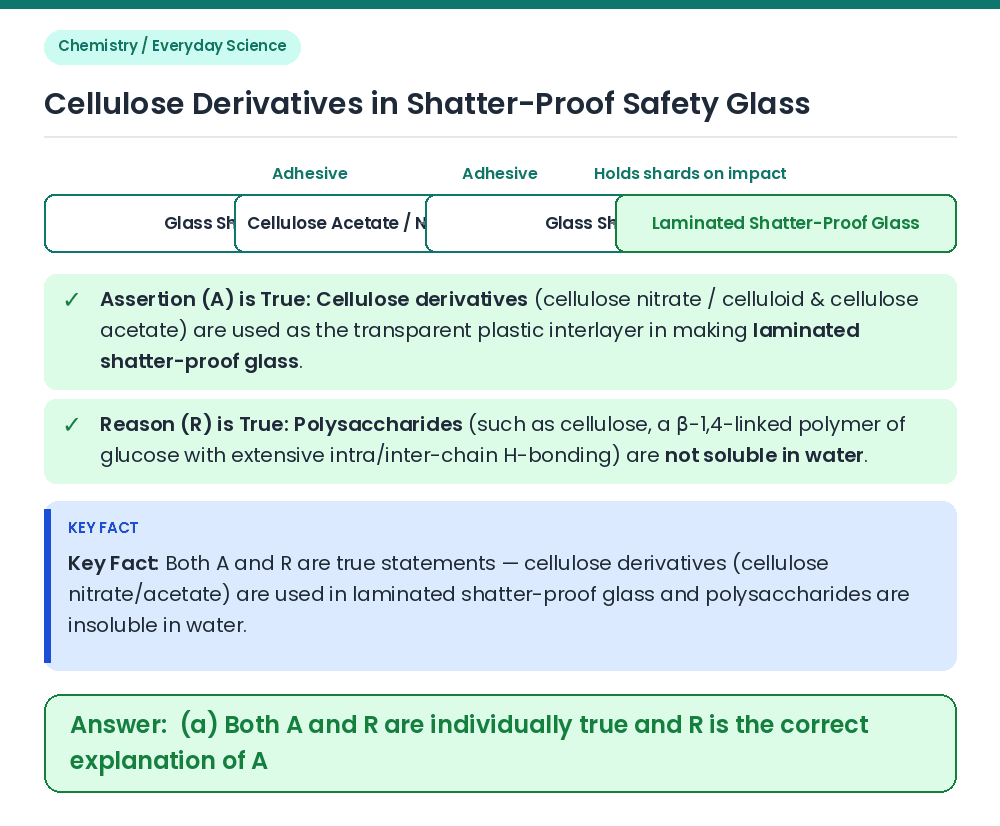
Assertion (A): Cellulose is used in making shatter proof glass. Reason (R): Polysaccharides are not soluble in water.
Show answer & explanationShow explanation
Answer: (A) Both A and R are individually true and R is the correct explanation of A
Given / Concept: Examine the industrial application of cellulose derivatives in safety glass and the solubility of structural polysaccharides. Evaluate A: Laminated shatter-proof glass (invented by Édouard Bénédictus in 1903) was originally made by sandwiching a thin transparent layer of cellulose nitrate (celluloid) or cellulose acetate between two sheets of glass so shards adhere on impact ⇒ A is true. Evaluate R: Cellulose is a structural polysaccharide made of β-D-glucose units with strong hydrogen bonding and is insoluble in water ⇒ R is true. Result: Both A and R are individually true and R is the correct explanation of A. Related Facts: • Modern Bulletproof / Laminated Glass: Uses Polyvinyl Butyral (PVB), Ethylene-Vinyl Acetate (EVA), or Polycarbonate interlayers. Correct Answer: (a) Both A and R are individually true and R is the correct explanation of A