Civil Services Examination · Question 92
Each of the persons A, B, C, D and E possesses unequal number (<10) of similar items. A, B and C possess 21 items in all, while C, D and E possess 7 items in all. How many items do A and B possess in all?
Show answer & explanationShow explanation
Answer: (B) 17
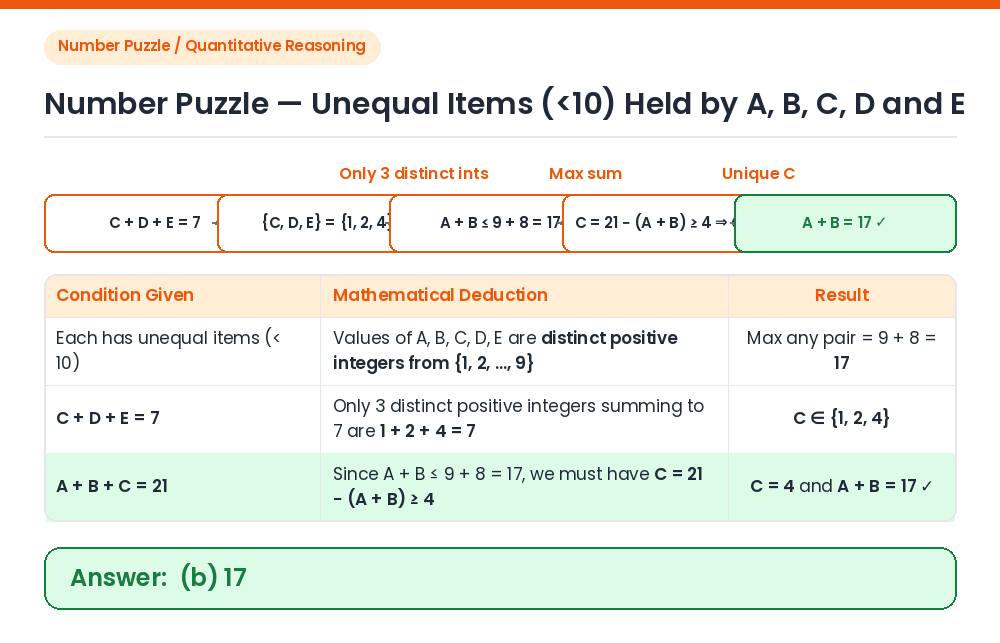
Given / Concept: A, B, C, D, and E each possess a distinct positive integer number of items less than 10, i.e., chosen from {1, 2, 3, 4, 5, 6, 7, 8, 9} without repetition. Analyze C + D + E = 7: The only set of 3 distinct positive integers whose sum is 7 is {1, 2, 4} (since 1 + 2 + 4 = 7). Hence C must be one of {1, 2, 4}. Analyze A + B + C = 21: Since A and B are distinct integers less than 10, the maximum possible sum of A + B is 9 + 8 = 17: ⇒ C = 21 − (A + B) ≥ 21 − 17 = 4. ⇒ Combining C ∈ {1, 2, 4} with C ≥ 4 forces C = 4 (and {A, B} = {8, 9}). ⇒ Therefore, A + B = 21 − C = 21 − 4 = 17. Result: A and B possess 17 items in all. Correct Answer: (b) 17