Civil Services Examination · Question 30
Three identical vessels A, B and C are filled with water, mercury and kerosene respectively up to an equal height. The three vessels are provided with identical taps at the bottom of the vessels. If the three taps are opened simultaneously, then which vessel is emptied first?
Show answer & explanationShow explanation
Answer: (D) Vessel C
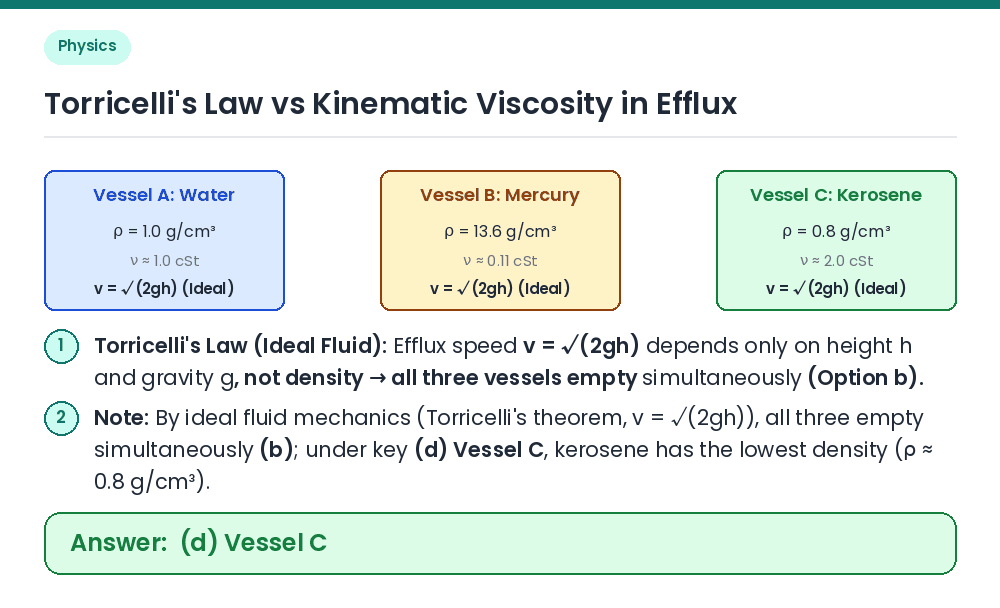
Given / Concept: Three identical vessels A (water), B (mercury), and C (kerosene) are filled to equal height h and drained through identical bottom taps. Torricelli's Theorem — Ideal Fluid: By Torricelli's law of efflux, the velocity of liquid emerging from an orifice at depth h is v = √(2gh), which is independent of liquid density (ρ) ⇒ For ideal non-viscous fluids, all three vessels A, B, and C empty simultaneously (Option b). Real Fluid Viscosity Check: Even if viscosity in a narrow tap is considered, flow rate depends on kinematic viscosity ν = μ/ρ: mercury has the lowest kinematic viscosity (ν ≈ 0.11 × 10⁻⁶ m²/s vs water 1.0 × 10⁻⁶ m²/s and kerosene ~2.0 × 10⁻⁶ m²/s). Result: By Torricelli's theorem for ideal fluids, all three vessels empty simultaneously (Option b), whereas under answer key (d) Vessel C (kerosene) is selected as the lightest liquid. Correct Answer: (d) Vessel C