Civil Services Examination · Question 149
There are two identical red, two identical black and two identical white balls. In how many different ways can the balls be placed in the cells (each cell to contain one ball) shown above such that balls of the same colour do not occupy any two consecutive cells?

Show answer & explanationShow explanation
Answer: (C) 24
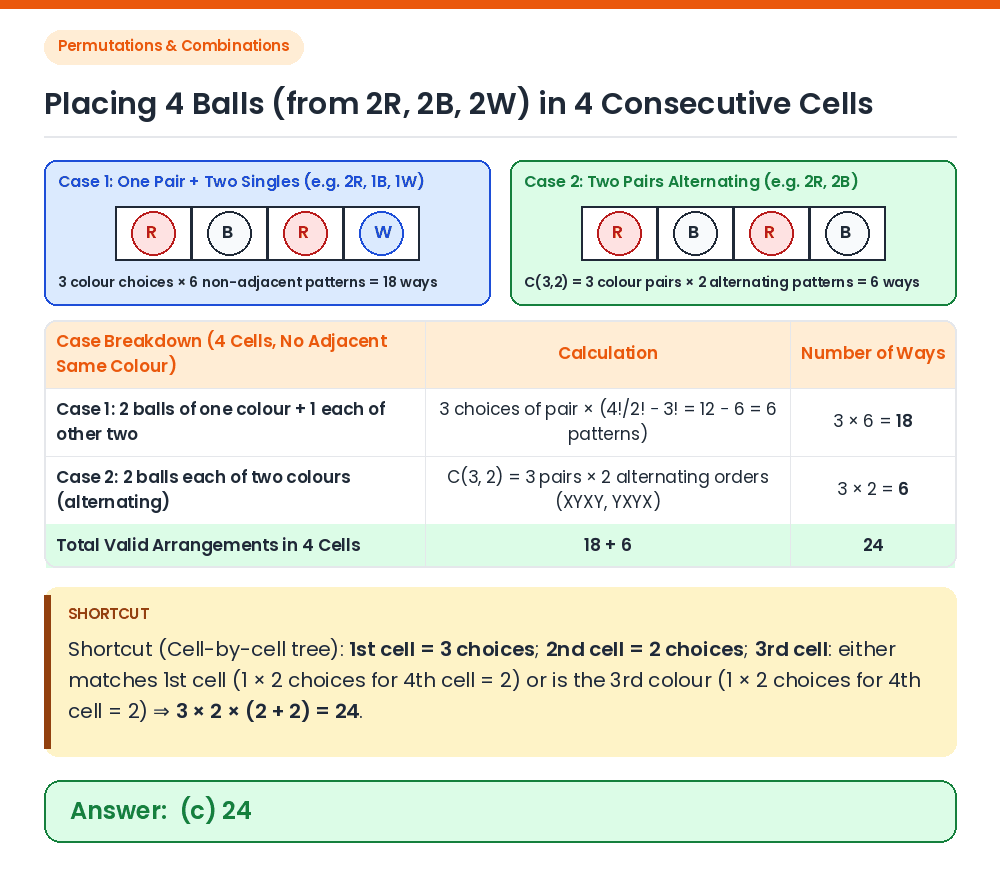
Given / Concept: The figure displays a horizontal strip of 4 consecutive cells, and we have a supply of 2 identical Red (R), 2 identical Black (B), and 2 identical White (W) balls. Each of the 4 cells contains 1 ball such that no two adjacent cells have the same colour. Case 1 — Two Balls of One Colour and One Each of the Other Two, e.g., 2R, 1B, 1W: There are 3 ways to choose which colour appears twice. For a fixed choice (2R, 1B, 1W), total arrangements in 4 cells = 4! / 2! = 12, and arrangements where the two R's are adjacent = 3! = 6 ⇒ valid ways = 12 − 6 = 6. Across all 3 colour choices: 3 × 6 = 18 ways. Case 2 — Two Balls Each of Two Colours, e.g., 2R and 2B: There are C(3, 2) = 3 ways to choose the two colours. For a fixed pair (2R, 2B), the only arrangements with no two adjacent balls of the same colour are the 2 alternating patterns (R B R B and B R B R) ⇒ 3 × 2 = 6 ways. Result: Total valid arrangements = 18 + 6 = 24. Shortcut: 1st cell has 3 colour choices, 2nd cell has 2 choices, 3rd cell has 2 choices (either same as 1st cell → 2 choices for 4th cell; or the 3rd colour → 2 choices for 4th cell) ⇒ 3 × 2 × (1×2 + 1×2) = 6 × 4 = 24. Correct Answer: (c) 24