Civil Services Examination · Question 24
There are four persons A, B, C, D; and A has some coins. A gave half of the coins to B and 4 more besides. B gave half of the coins to C and 4 more besides. C gave half of the coins to D and 4 more besides. Both B and D end up with same number of coins. How many coins did A have originally ?
Show answer & explanationShow explanation
Answer: (C) 72
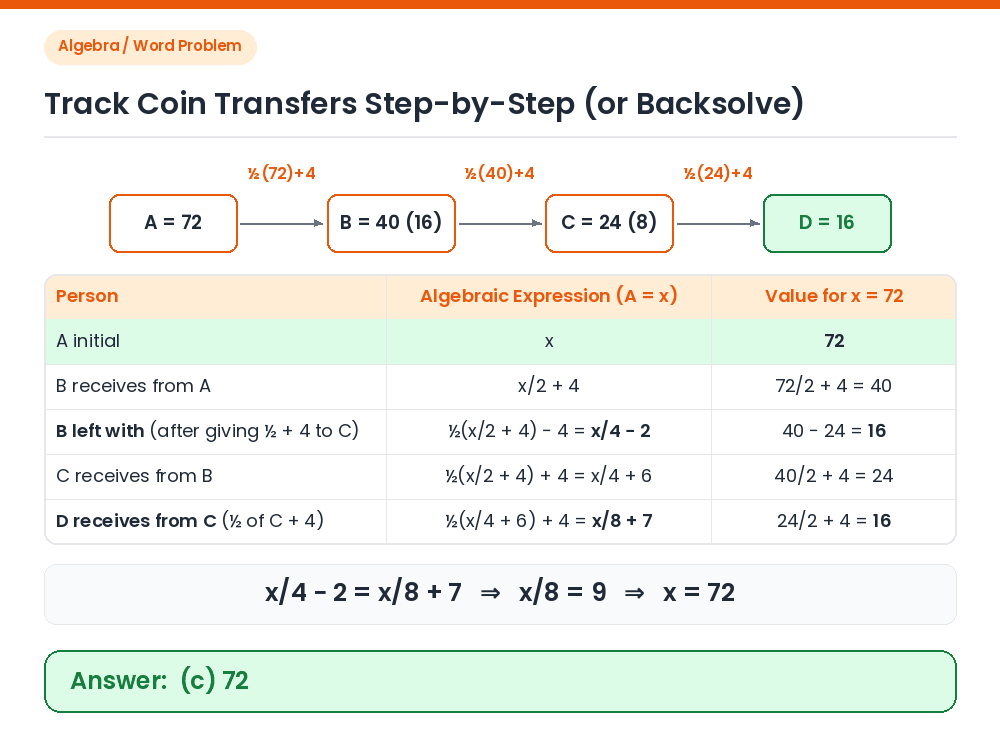
Given: Let A originally have x coins; each transfer gives (half + 4) coins, and B's final coins = D's final coins. Coins with B: B receives (x/2 + 4) from A, and gives half of that plus 4 to C: ⇒ B is left with = (x/2 + 4)/2 − 4 = x/4 − 2. Coins with C and D: C receives (x/2 + 4)/2 + 4 = x/4 + 6 from B. C then gives half of that plus 4 to D: ⇒ D receives = (x/4 + 6)/2 + 4 = x/8 + 7. Equate B and D: x/4 − 2 = x/8 + 7 ⇒ x/8 = 9 ⇒ x = 72. Shortcut (Option Check): Try 72 → B gets 36+4 = 40; B gives 20+4 = 24 to C (so B has 40−24 = 16 left); D gets 12+4 = 16 from C. Since 16 = 16, 72 is correct. Correct Answer: (c) 72