Civil Services Examination · Question 11
Chlorination is a process used for water purification. The disinfecting action of chlorine is mainly due to
Show answer & explanationShow explanation
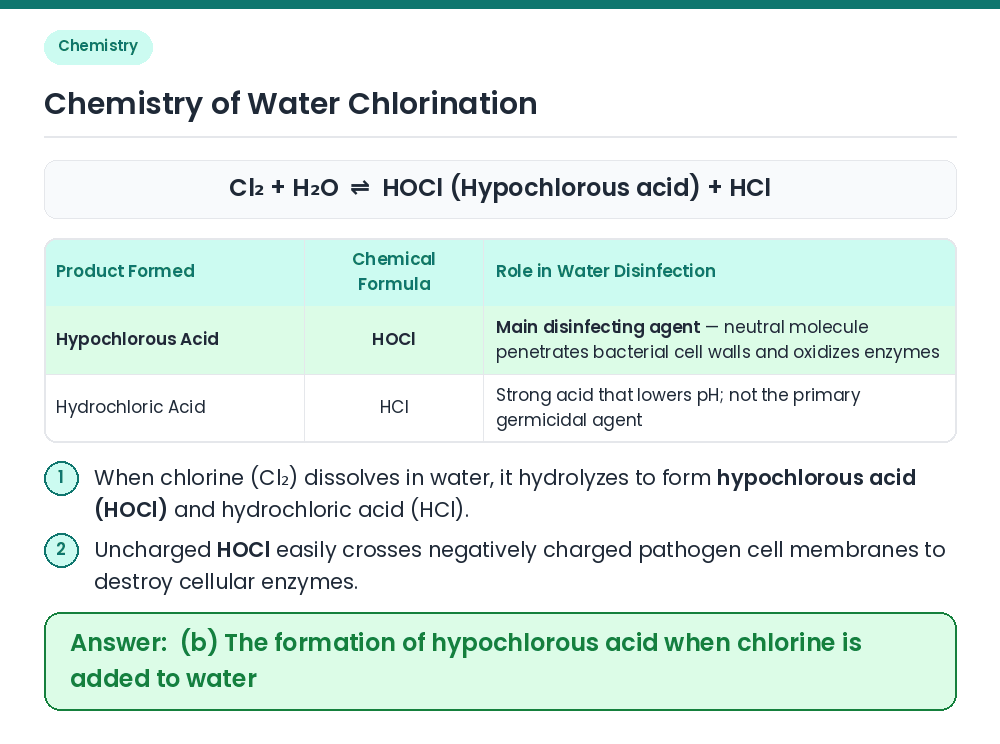
Answer: (B) The formation of hypochlorous acid when chlorine is added to water
Reaction: When chlorine gas (Cl₂) or hypochlorite is added to water, it undergoes disproportionation: Cl₂ + H₂O ⇌ HOCl (hypochlorous acid) + HCl (hydrochloric acid). Mechanism: Hypochlorous acid (HOCl) is electrically neutral and has a low molecular weight, allowing it to diffuse rapidly through the negatively charged cell walls of bacteria and viruses. Germicidal Action: Inside the pathogen, HOCl oxidizes sulfhydryl groups of essential respiratory enzymes and disrupts DNA/protein synthesis. Result: The disinfecting action of chlorine is mainly due to the formation of hypochlorous acid (HOCl). Related Facts: • Together, dissolved Cl₂, HOCl, and hypochlorite ion (OCl⁻) are referred to as 'free available chlorine'. • HOCl is roughly 80 to 100 times more effective as a disinfectant than the charged OCl⁻ ion, making chlorination most effective at pH 5.5–7.5. Correct Answer: (b) The formation of hypochlorous acid when chlorine is added to water