Civil Services Examination · Question 17
In order to comply with TRIPS Agreement, India enacted the Geographical Indications of Goods (Registration & Protection) Act, 1999. The difference/differences between a "Trade Mark" and a Geographical Indication is/are 1. A Trade Mark is an individual or a company's right whereas a Geographical Indication is a community's right. 2. A Trade Mark can be licensed whereas a Geographical Indication cannot be licensed. 3. A Trade Mark is assigned to the manufactured goods whereas the Geographical Indication is assigned to the agricultural goods/products and handicrafts only. Which of the statements given above is/are correct?
Show answer & explanationShow explanation
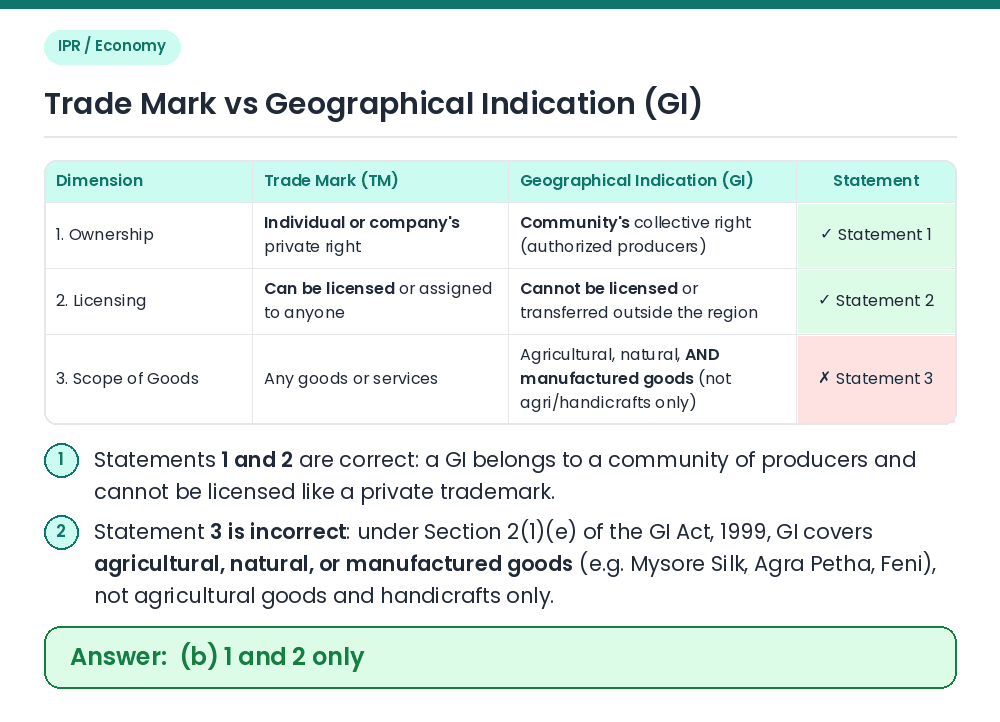
Answer: (B) 1 and 2 only
Compare Ownership & Licensing: A Trade Mark is a private right owned by an individual or enterprise and can be licensed/assigned to third parties (Statements 1 & 2 ✓), whereas a Geographical Indication (GI) is a collective public right of the producers in a specific region and its transmission/licensing is prohibited under Section 24 of the GI Act, 1999. Check Statement 3: Under Section 2(1)(e) of the GI Act, 1999, a GI can be registered for agricultural goods, natural goods, OR manufactured goods (including foodstuffs and industrial products), not agricultural goods and handicrafts 'only' ⇒ Statement 3 is incorrect. Result: Only statements 1 and 2 are correct. Related Facts: • The Geographical Indications of Goods (Registration and Protection) Act, 1999 came into force on 15 September 2003, with the GI Registry located in Chennai. • Darjeeling Tea was the first Indian product to receive a GI tag in 2004–05. Correct Answer: (b) 1 and 2 only