Civil Services Examination · Question 2
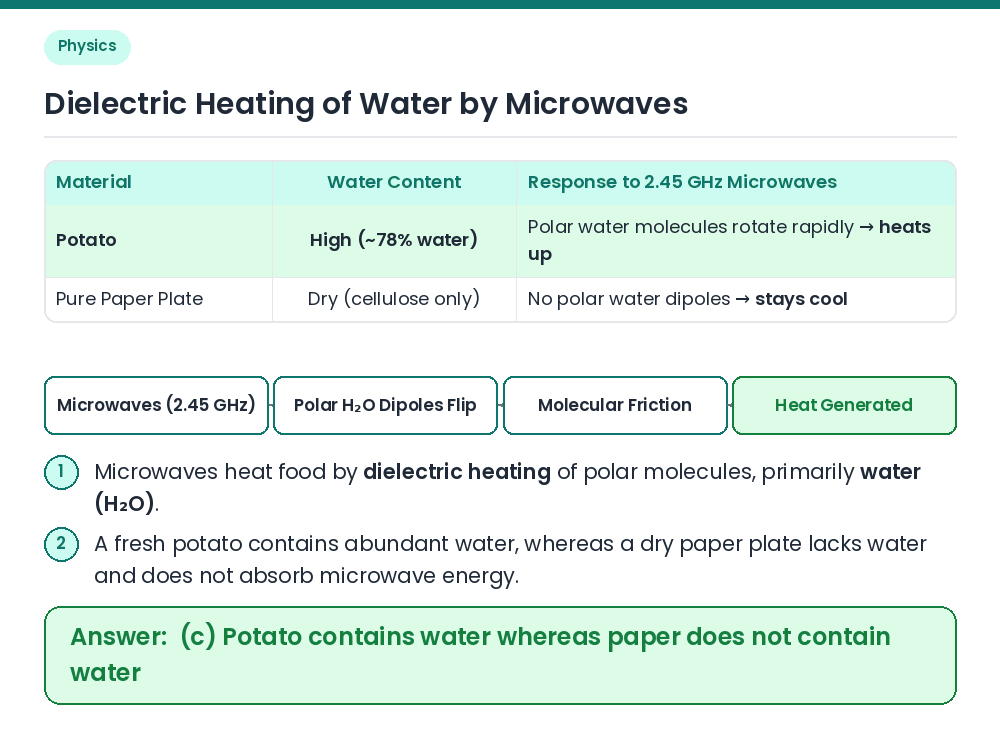
If a potato is placed on a pure paper plate which is white and unprinted and put in a microwave oven, the potato heats up but the paper plate does not. This is because
Show answer & explanationShow explanation
Answer: (C) Potato contains water whereas paper does not contain water
Concept: Microwave ovens heat substances through dielectric heating, where oscillating electromagnetic waves interact with polar molecules. Role of Water: Water (H₂O) is a strongly polar molecule that aligns and flips billions of times per second in a 2.45 GHz microwave field ⇒ generating thermal energy via intermolecular friction. Comparison: A potato contains ~78% water so it absorbs microwaves and heats up, whereas a dry paper plate contains no free water. Result: The potato heats up because it contains water while the paper plate does not. Related Facts: • Domestic microwave ovens operate at a frequency of approximately 2.45 GHz (wavelength ~12.2 cm). • Glass, ceramic, and dry paper are largely transparent to microwaves unless heated by conduction from hot food. Correct Answer: (c) Potato contains water whereas paper does not contain water