Civil Services Examination · Question 39
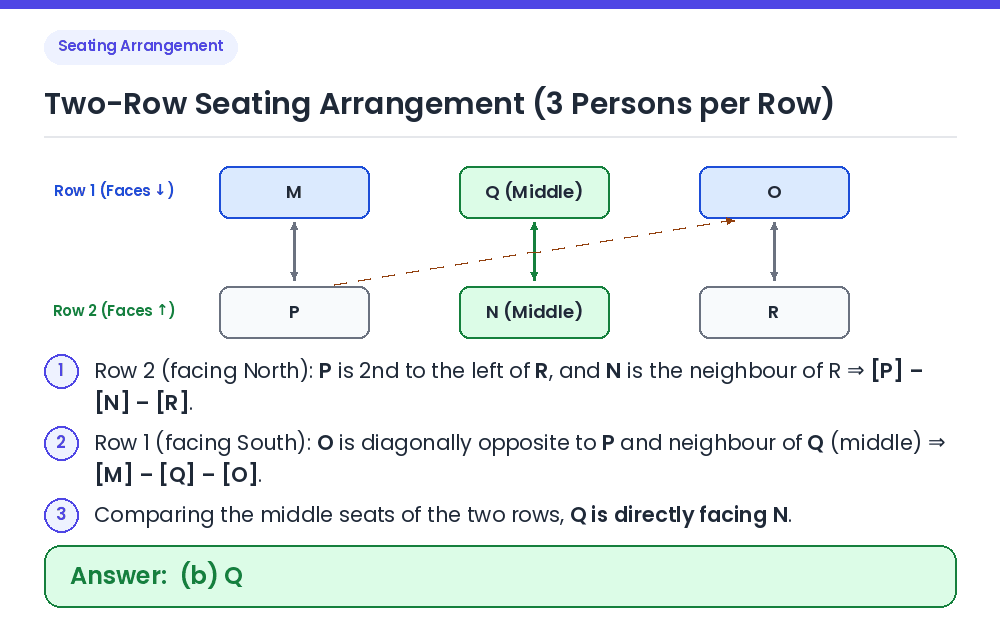
Six persons M, N, O, P, Q and R are sitting in two rows, three in each. Q is not at the end of any row. P is second to the left of R. O is the neighbour of Q and is sitting diagonally opposite to P. N is the neighbour of R. On the basis of above information, who is facing N?
Show answer & explanationShow explanation
Answer: (B) Q
Place P, Q, R: There are 2 rows of 3 seats each (Left, Middle, Right). Since P is second to the left of R, P and R must occupy the two extreme ends of one row: [P] — [Middle] — [R]. Place O and Q: O is sitting diagonally opposite to P, which means O is at the right end of the other row. Since O is a neighbour of Q and Q is not at the end of any row ⇒ Q is in the middle of O's row: [M] — [Q] — [O]. Place N: N is the neighbour of R (and lies between P and R in the first row): [P] — [N] — [R]. Result: Comparing the two rows ([P, N, R] facing [M, Q, O]), the two middle persons N and Q directly face each other ⇒ Q is facing N. Shortcut: Q is given as not at the end of any row (so Q is in the middle seat), and N is between P and R (middle seat of the other row) ⇒ the two middle seats Q and N must face each other! Correct Answer: (b) Q