Civil Services Examination · Question 88
What is the principle by which a cooling system (Radiator) in a motor car works?
Show answer & explanationShow explanation
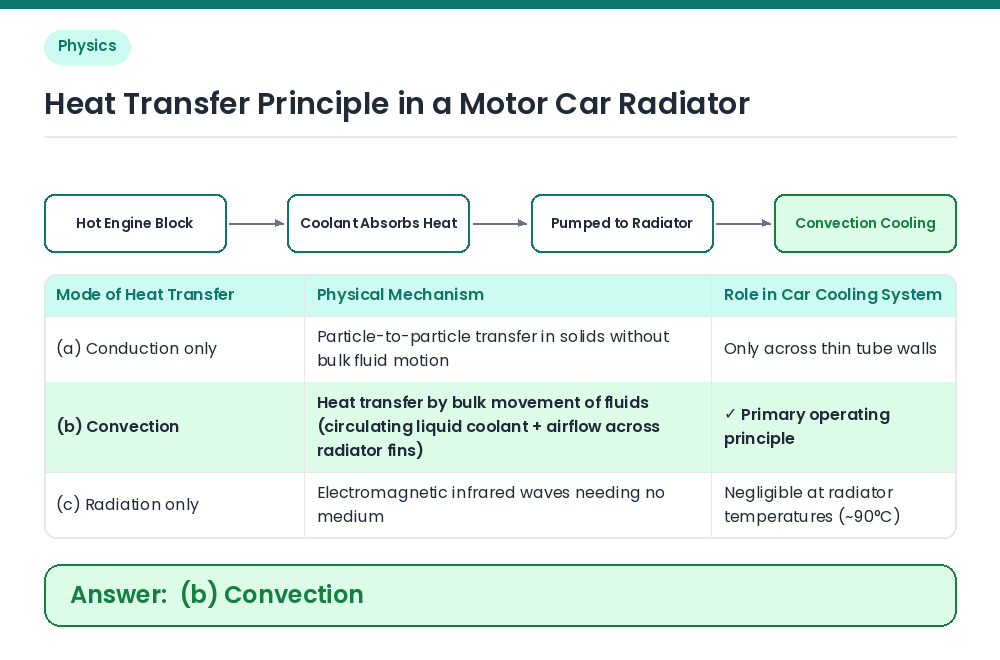
Answer: (B) Convection
Concept: Heat transfer occurs via three primary mechanisms: conduction (through stationary solids), convection (through bulk movement of liquids and gases), and radiation (electromagnetic waves). How a Car Radiator Works: Despite its name ('radiator'), a motor car cooling system operates primarily by forced convection: a water pump circulates liquid coolant through the hot engine block to absorb heat and carries the heated fluid to the radiator, where a fan and ram air convect the heat away into the surrounding atmosphere. Result: The cooling system (radiator) in a motor car works on the principle of convection. Related Facts: • Ethylene glycol (antifreeze) is mixed with water in car radiators because it lowers the freezing point and raises the boiling point of the coolant. • Water is an ideal base coolant because of its exceptionally high specific heat capacity (~4,184 J/kg·K). Correct Answer: (b) Convection