Civil Services Examination · Question 21
Read the following passage and answer the item that follows. Your answer to this item should be based on the passage only. Passage: A moral act must be our own act; must spring from our own will. If we act mechanically, there is no moral content in our act. Such action would be moral, if we think it proper to act like a machine and do so. For, in doing so, we use our discrimination. We should bear in mind the distinction between acting mechanically and acting intentionally. It may be moral of a king to pardon a culprit. But the messenger carrying out the order of pardon plays only a mechanical part in the king's moral act. But if the messenger were to carry out the king's order considering it to be his duty, his action would be a moral one. How can a man understand morality who does not use his own intelligence and power of thought, but lets himself be swept along like a log of wood by a current? Sometimes a man defies convention and acts on his own with a view to absolute good. Question: Which of the following statements is the nearest definition of moral action, according to the writer?
Show answer & explanationShow explanation
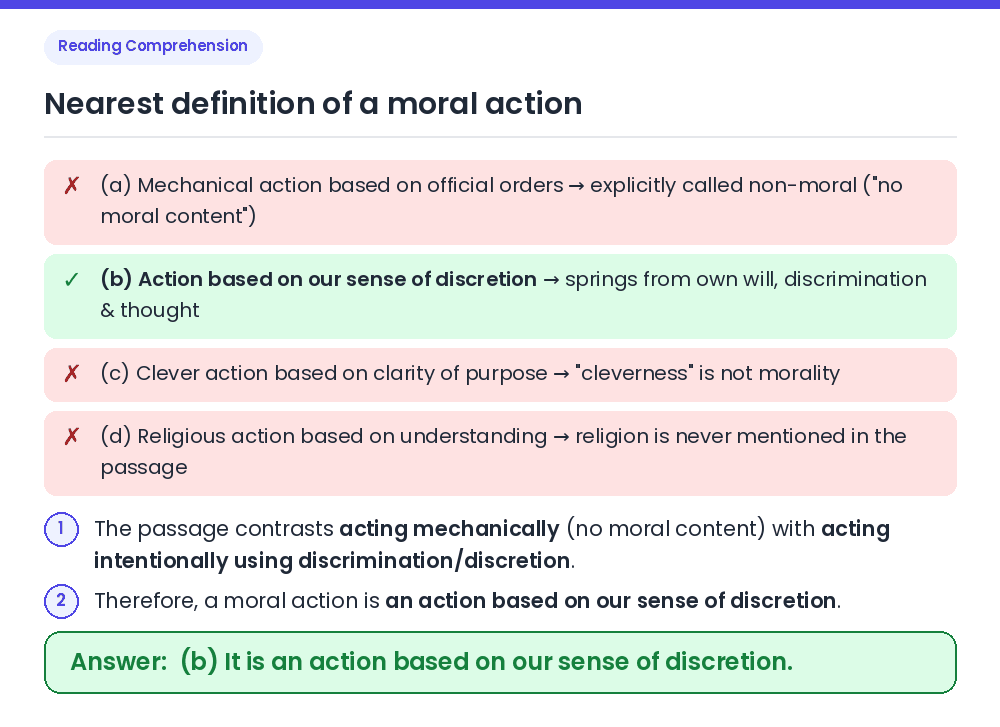
Answer: (B) It is an action based on our sense of discretion.
Given / Concept: Look at how the writer defines a moral act in the opening sentences of Passage 4. Eliminate Wrong Options: Mechanical action has no moral content ((a) is false), and neither cleverness ((c)) nor religion ((d)) is mentioned. Verify Correct Option: The writer states that a moral act must spring from our own will, intelligence and discrimination (sense of discretion / विवेक-बोध). Result: Option (b) is the nearest definition of moral action. Correct Answer: (b) It is an action based on our sense of discretion.