Civil Services Examination · Question 44
Read the following passage and answer the item that follows. Your answer to this item should be based on the passage only. Passage: A species that exerts an influence out of proportion to its abundance in an ecosystem is called a keystone species. The keystone species may influence both the species richness of communities and the flow of energy and materials through ecosystems. The sea star Pisaster ochraceus, which lives in rocky intertidal ecosystems on the Pacific coast of North America, is also an example of a keystone species. Its preferred prey is the mussel Mytilus californianus. In the absence of sea stars, these mussels crowd out other competitors in a broad belt of the intertidal zone. By consuming mussels, sea star creates bare spaces that are taken over by a variety of other species. A study at the University of Washington demonstrated the influence of Pisaster on species richness by removing sea stars from selected parts of the intertidal zone repeatedly over a period of five years. Two major changes occurred in the areas from which sea stars were removed. First, the lower edge of the mussel bed extended farther down into the intertidal zone, showing that sea stars are able to eliminate mussels completely where they are covered with water most of the time. Second, and more dramatically, 28 species of animals and algae disappeared from the sea star removal zone. Eventually only Mytilus, the dominant competitor, occupied the entire substratum. Through its effect on competitive relationships, predation by Pisaster largely determines which species live in these rocky intertidal ecosystems. Question: What is the crux of the passage?
Show answer & explanationShow explanation
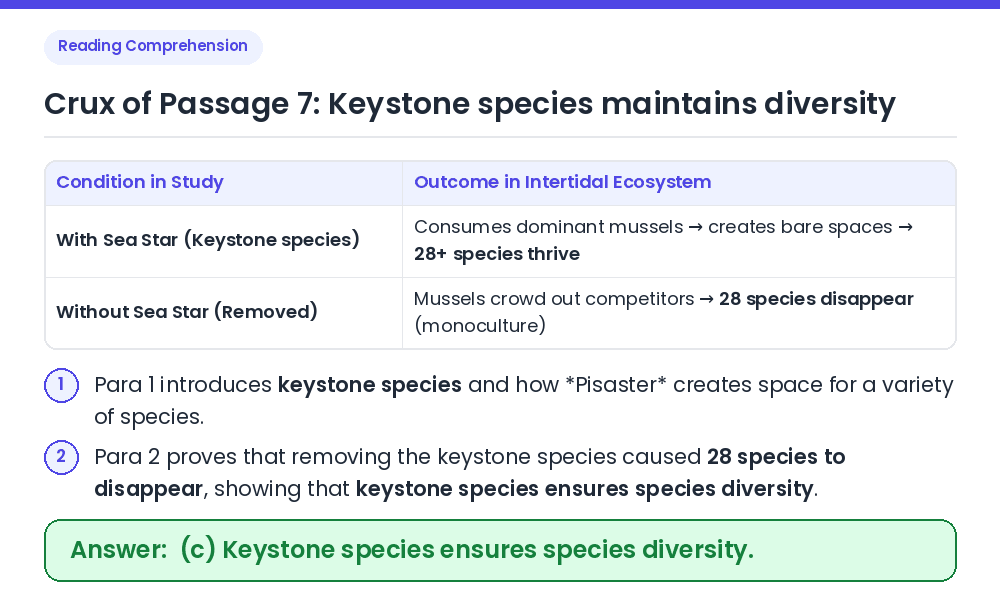
Answer: (C) Keystone species ensures species diversity.
Given / Concept: The crux of a passage is the central thesis that the example and experimental study are used to prove. Analyze Passage: Para 1 defines keystone species as influencing species richness, and Para 2 demonstrates via the University of Washington study that removing the sea star caused 28 species to vanish. Eliminate Other Options: (a) is a minor fact, (b) reverses the causal relationship, and (d) is false because the passage says the sea star is 'also an example'. Result: The crux is that a keystone species ensures species diversity. Correct Answer: (c) Keystone species ensures species diversity.