Civil Services Examination · Question 56
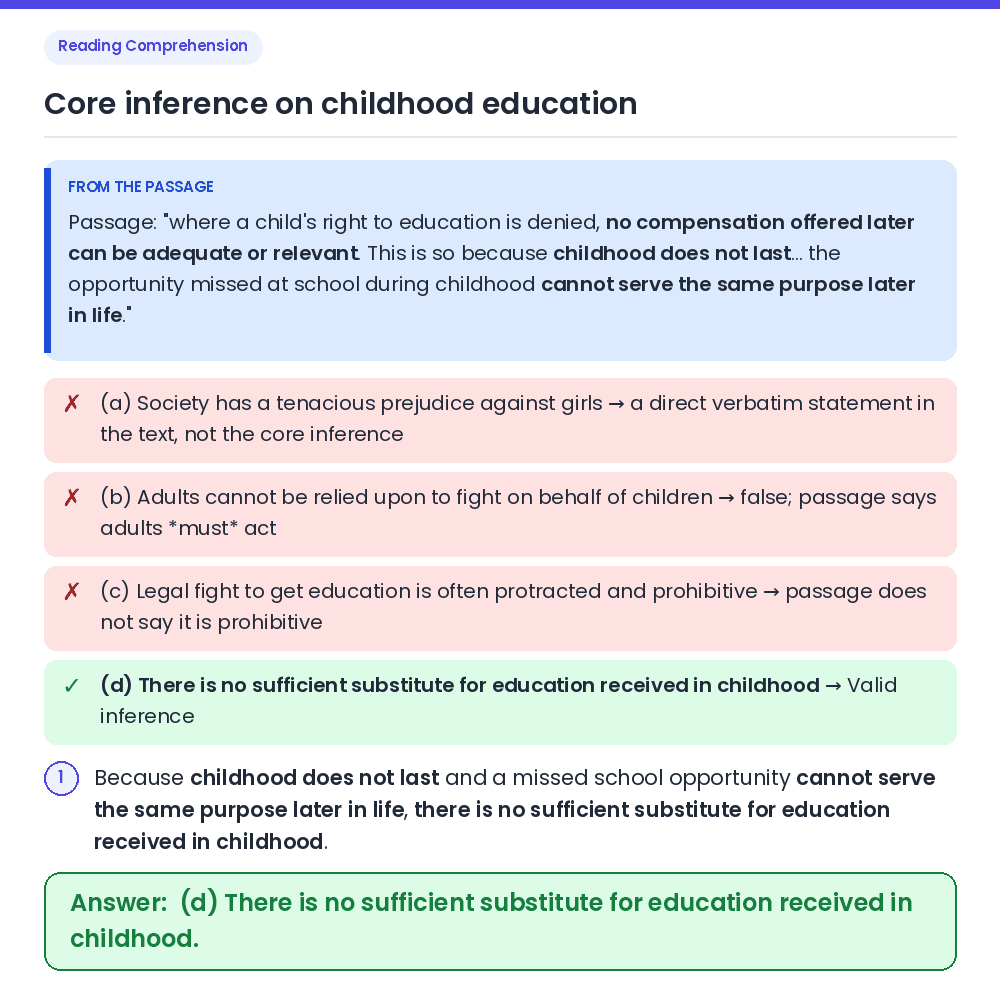
Read the following passage and answer the item that follows. Your answer to this item should be based on the passage only. Passage: Now India's children have a right to receive at least eight years of education, the gnawing question is whether it will remain on paper or become a reality. One hardly needs a reminder that this right is different from the others enshrined in the Constitution, that the beneficiary — a six year old child cannot demand it, nor can she or he fight a legal battle when the right is denied or violated. In all cases, it is the adult society which must act on behalf of the child. In another peculiarity, where a child's right to education is denied, no compensation offered later can be adequate or relevant. This is so because childhood does not last. If a legal battle fought on behalf of a child is eventually won, it may be of little use to the boy or girl because the opportunity missed at school during childhood cannot serve the same purpose later in life. This may be painfully true for girls because our society permits them only a short childhood, if at all. The Right to Education (RTE) has become law at a point in India's history when the ghastly practice of female infanticide has resurfaced in the form of foeticide. This is "symptomatic of a deeper turmoil" in society which is compounding the traditional obstacles to the education of girls. Tenacious prejudice against the intellectual potential of girls runs across our cultural diversity and the system of education has not been able to address it. Question: Which one of the following statements conveys the inference of the passage?
Show answer & explanationShow explanation
Answer: (D) There is no sufficient substitute for education received in childhood.
Given / Concept: Distinguish between a restatement/unsupported claim and the logical inference drawn from the passage's argument on childhood. Analyze Evidence: The passage states that when a child's right to education is denied, no later compensation is adequate or relevant because childhood does not last and missed schooling cannot serve the same purpose later in life. Eliminate Other Options: (a) is a verbatim fact from the last line rather than an inference across the passage, while (b) and (c) are unsupported. Result: The inference is that there is no sufficient substitute for education received in childhood. Correct Answer: (d) There is no sufficient substitute for education received in childhood.