Civil Services Examination · Question 10
Consider the following actions which the Government can take : 1. Devaluing the domestic currency. 2. Reduction in the export subsidy. 3. Adopting suitable policies which attract greater FDI and more funds from FIIs. Which of the above action/actions can help in reducing the current account deficit ?
Show answer & explanationShow explanation
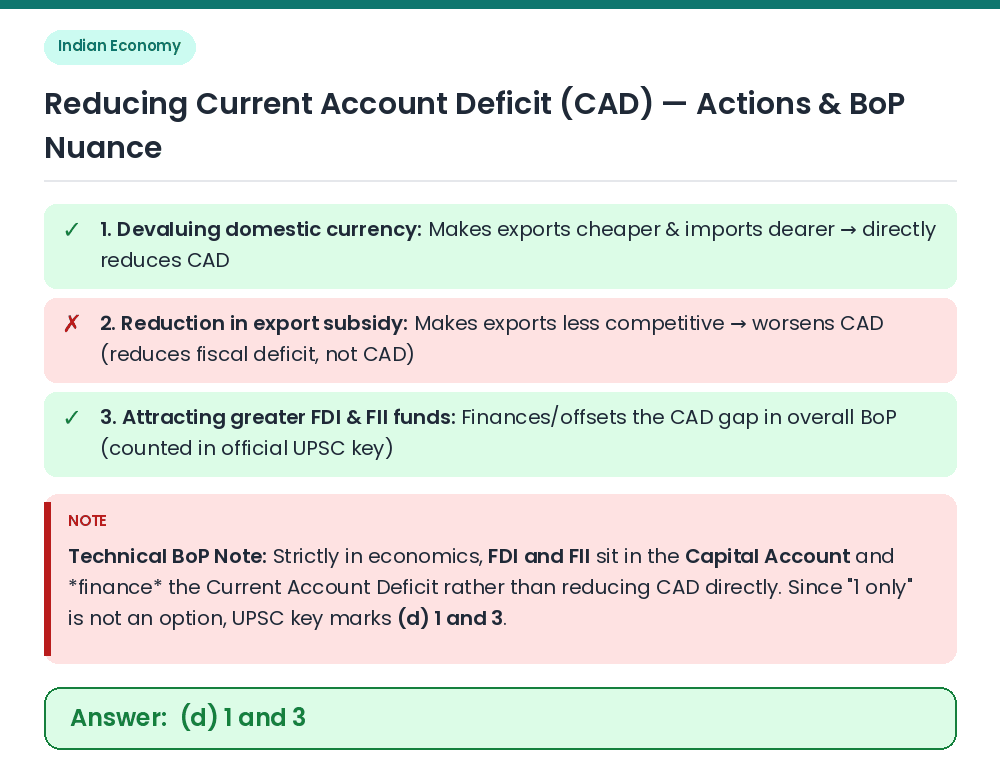
Answer: (D) 1 and 3
Analyze Statement 1 — Currency Devaluation: Devaluing the domestic currency makes domestic exports cheaper in foreign markets and foreign imports more expensive domestically (by the Marshall-Lerner condition), which boosts net exports and reduces the Current Account Deficit (CAD). Statement 1 is correct. Analyze Statement 2 — Cutting Export Subsidy: Reducing export subsidies lowers the price competitiveness of exporters, reducing export earnings and widening the CAD (though it reduces the government's fiscal deficit). Statement 2 is incorrect. Analyze Statement 3 & Key Discrepancy Note: Strictly under Balance of Payments (BoP) accounting, FDI and FII inflows belong to the Capital Account, not the Current Account — so they help finance/offset the Current Account Deficit in the overall BoP rather than directly shrinking the current account gap (and profit/dividend repatriation actually adds to current account outflows). However, since '1 only' is not among the options and UPSC framed the question around easing BoP/CAD pressure, the official UPSC key is (d) 1 and 3. Related Facts: • India's Balance of Payments (BoP) consists of the Current Account (merchandise trade + invisibles) and the Capital Account (FDI, FPI, external borrowings). • Currency devaluation improves the trade balance when the sum of price elasticities of export and import demand exceeds 1 (Marshall–Lerner condition). Correct Answer: (d) 1 and 3