Civil Services Examination · Question 28
Both Foreign Direct Investment (FDI) and Foreign Institutional Investor (FII) are related to investment in a country. Which one of the following statements best represents an important difference between the two ?
Show answer & explanationShow explanation
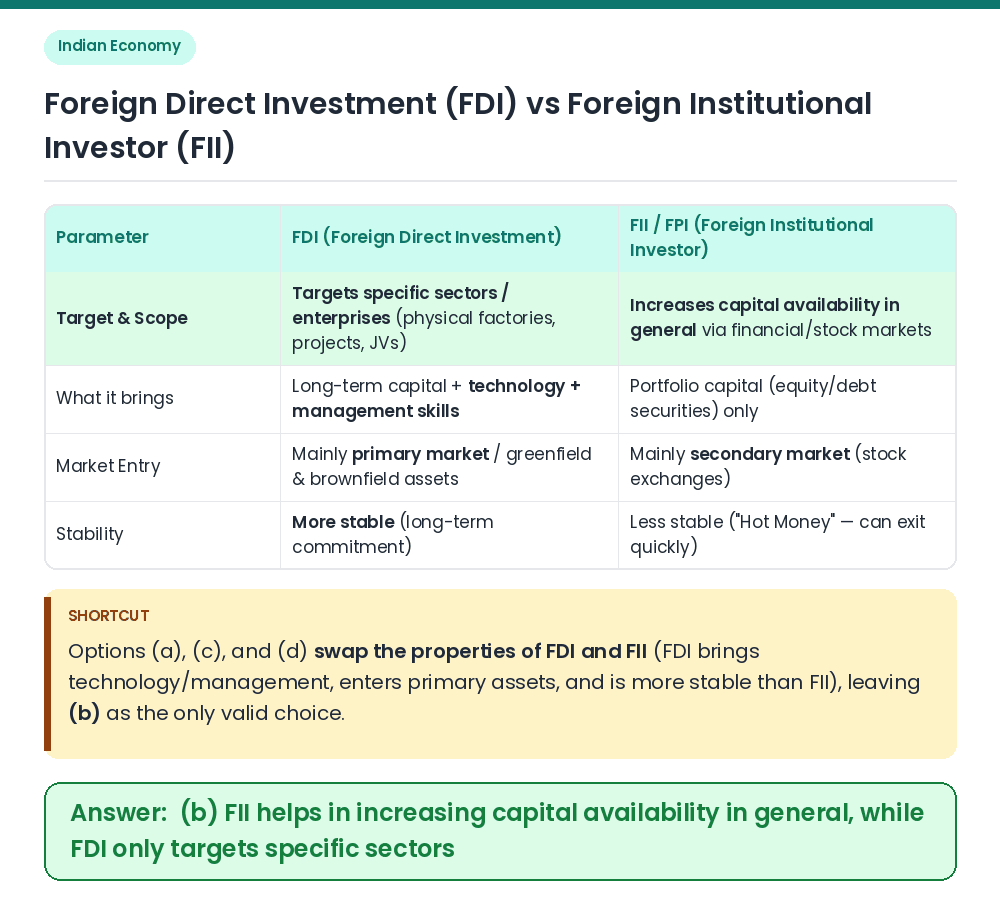
Answer: (B) FII helps in increasing capital availability in general, while FDI only targets specific sectors
Eliminate reversed statements a, c, and d: (a) is reversed because FDI (not FII) brings management skills and technology along with capital; (c) is reversed because FII operates predominantly in the secondary market (stock exchange) while FDI creates real productive assets; (d) is reversed because FDI is long-term and far more stable than FII ('hot money'). Confirm option b: FII inflows into the capital market increase liquidity and capital availability in the economy in general, whereas FDI is directed into specific sectors and companies. Related Facts: • Based on the K.M. Chandrasekhar Committee (2013) and Arvind Mayaram Committee (2014), foreign investment <10% in a listed company's paid-up capital is classified as FPI (FII), while ≥10% is classified as FDI. • In India, an investment above 10% of post-issue paid-up equity capital in a listed company is classified as FDI, whereas 10% or less is classified as FPI/FII (Arvind Mayaram Committee norm). Correct Answer: (b) FII helps in increasing capital availability in general, while FDI only targets specific sectors