Civil Services Examination · Question 4
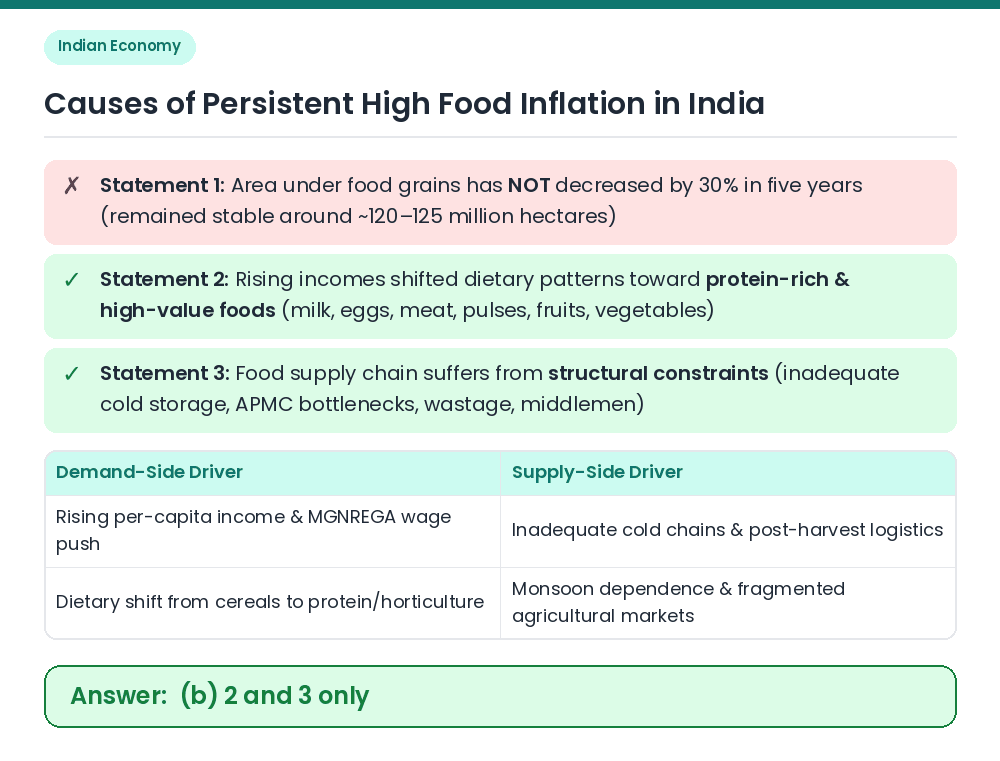
India has experienced persistent and high food inflation in the recent past. What could be the reasons ? 1. Due to a gradual switchover to the cultivation of commercial crops, the area under the cultivation of food grains has steadily decreased in the last five years by about 30%. 2. As a consequence of increasing incomes, the consumption patterns of the people have undergone a significant change. 3. The food supply chain has structural constraints. Which of the statements given above are correct ?
Show answer & explanationShow explanation
Answer: (B) 2 and 3 only
Evaluate Statement 1: The gross cropped area under food grains in India remained broadly stable (around 120–126 million hectares) and never declined by 30% over five years. Statement 1 is an extreme and factually false statement. Evaluate Statement 2 — Demand-pull factor: Rising per-capita incomes led to Bennett's Law in action — a structural shift in consumption patterns away from staple cereals toward protein-rich and high-value items (pulses, milk, eggs, meat, vegetables, fruits). Statement 2 is correct. Evaluate Statement 3 — Supply-side bottleneck: Structural constraints in the food supply chain — poor cold-storage infrastructure, multi-layered intermediaries, and transport bottlenecks — prevented supply from matching rising demand. Statement 3 is correct. Related Facts: • Eliminating Statement 1 immediately rules out (a), (c), and (d), leaving (b) 2 and 3 only. • Minimum Support Price (MSP) hikes and rising rural wages also contributed to demand-pull and cost-push food inflation during 2009–11. Correct Answer: (b) 2 and 3 only