Civil Services Examination · Question 40
A company marketing food products advertises that its items do not contain trans-fats. What does this campaign signify to the customers ? 1. The food products are not made out of hydrogenated oils. 2. The food products are not made out of animal fats/oils. 3. The oils used are not likely to damage the cardiovascular health of the consumers. Which of the statements given above is/are correct ?
Show answer & explanationShow explanation
Answer: (C) 1 and 3 only
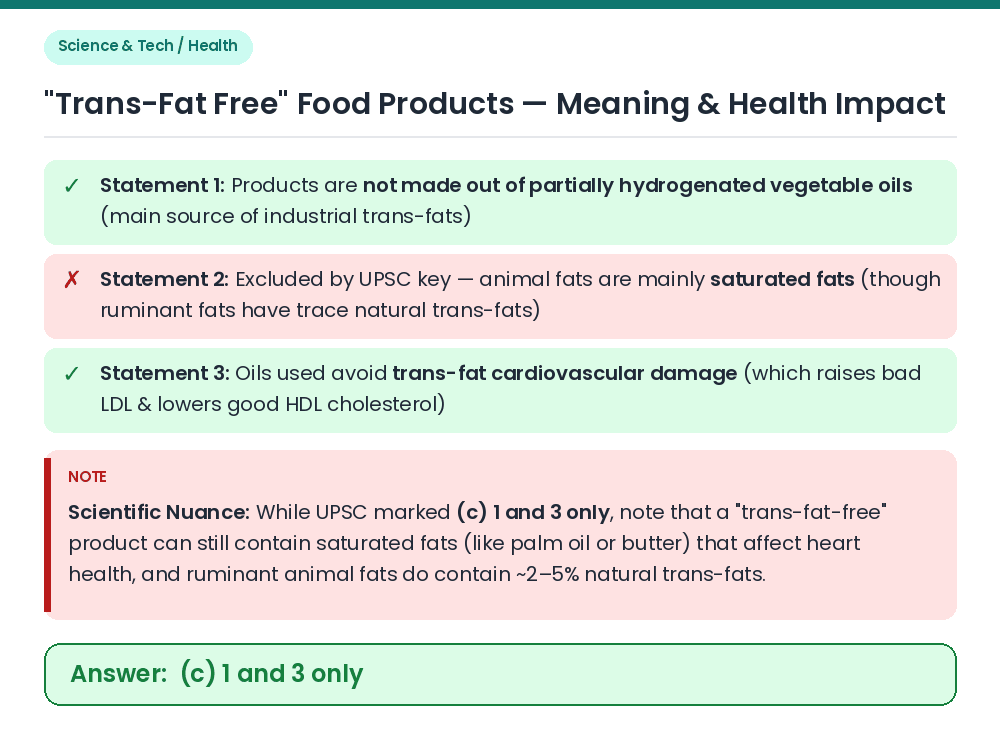
Analyze Statement 1 — Hydrogenated Oils: Industrial trans-fatty acids are formed during the partial hydrogenation of liquid vegetable oils (using a Nickel catalyst to make vanaspati/margarine). Therefore, advertising 'no trans-fats' directly signifies that the products are not made from partially hydrogenated oils. Statement 1 is correct. Analyze Statements 2 & 3 and Scientific Nuance: In UPSC's official key, Statement 2 is treated as incorrect (since animal fats are primarily associated with saturated fats rather than industrial hydrogenated trans-fats) and Statement 3 is treated as correct (since eliminating trans-fats protects cardiovascular health by avoiding a rise in LDL and drop in HDL cholesterol). Note on scientific nuance: Strictly speaking, ruminant animal fats do contain small amounts (2–5%) of natural trans-fats, and a trans-fat-free oil high in saturated fat (e.g., palm oil) could still impact cardiovascular health; however, following the official UPSC key, (c) 1 and 3 only is the designated answer. Related Facts: • Industrial trans-fats are formed during partial hydrogenation of vegetable oils (converting liquid cis-unsaturated fats into solid trans-fats like vanaspati). • Trans-fats raise LDL ('bad' cholesterol) and lower HDL ('good' cholesterol); WHO's REPLACE initiative targets global elimination of industrially produced trans-fats. Correct Answer: (c) 1 and 3 only