Civil Services Examination · Question 50
The surface of a lake is frozen in severe winter, but the water at its bottom is still liquid. What is the reason ?
Show answer & explanationShow explanation
Answer: (C) The density of water is maximum at 4°C
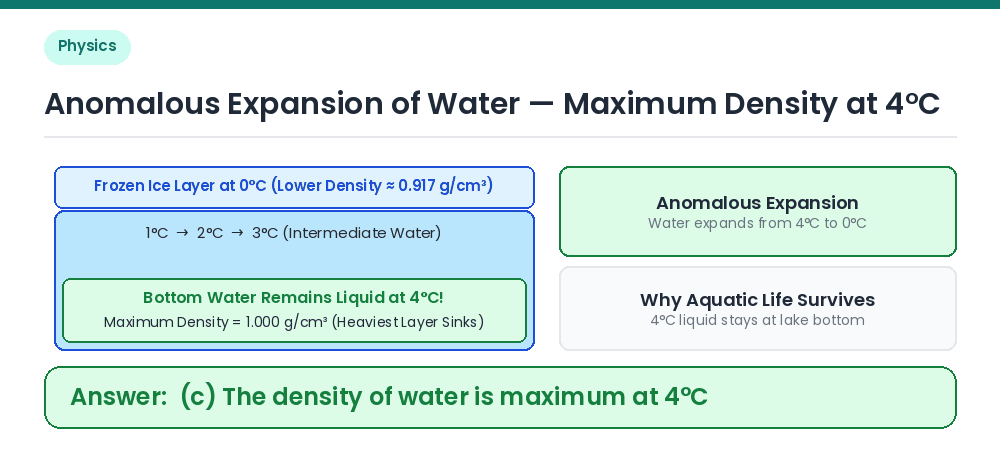
Anomalous expansion of water: Unlike most liquids, water exhibits anomalous expansion between 4°C and 0°C — as water cools down to 4°C, its density reaches a maximum (1.000 g/cm³), causing the 4°C water to sink to the bottom of the lake. Surface freezing while bottom stays at 4°C: When surface water cools further below 4°C toward 0°C, it expands and becomes less dense than the 4°C water below, so the colder water (0°C–3°C) and ice remain floating at the top while the denser 4°C water at the bottom stays liquid. (Note: While ice being a poor conductor of heat also slows heat loss from below, the fundamental physical reason water at the bottom remains liquid at 4°C while freezing starts at the top is that the density of water is maximum at 4°C.) Related Facts: • Water shows anomalous expansion between 4°C and 0°C: it contracts on cooling down to 4°C (reaching maximum density of 1.000 g/cm³) and expands on cooling further from 4°C to 0°C. • Because ice (density ~0.917 g/cm³) floats on top and acts as a thermal insulator, aquatic life survives in the 4°C liquid water at the bottom. Correct Answer: (c) The density of water is maximum at 4°C