Civil Services Examination · Question 56
Directions: Read the following passage and answer the item that follows. Your answer to this item should be based on the passage only. Passage – 2 In a typical Western liberal context, deepening of democracy invariably leads to consolidation of 'liberal values'. In the Indian context, democratization is translated into greater involvement of people not as 'individuals' which is a staple to liberal discourse, but as communities or groups. Individuals are getting involved in the public sphere not as 'atomized' individuals but as members of primordial communities drawn on religious or caste identity. Community-identity seems to be the governing force. It is not therefore surprising that the so-called peripheral groups continue to maintain their identities with reference to the social groups (caste, religion or sect) to which they belong while getting involved in the political processes despite the fact that their political goals remain more or less identical. By helping to articulate the political voice of the marginalized, democracy in India has led to 'a loosening of social strictures' and empowered the peripherals to be confident of their ability to improve the socio-economic conditions in which they are placed. This is a significant political process that had led to a silent revolution through a meaningful transfer of power from the upper caste elites to various subaltern groups within the democratic framework of public governance. What is the "silent revolution" that has occurred in the Indian democratic process?
Show answer & explanationShow explanation
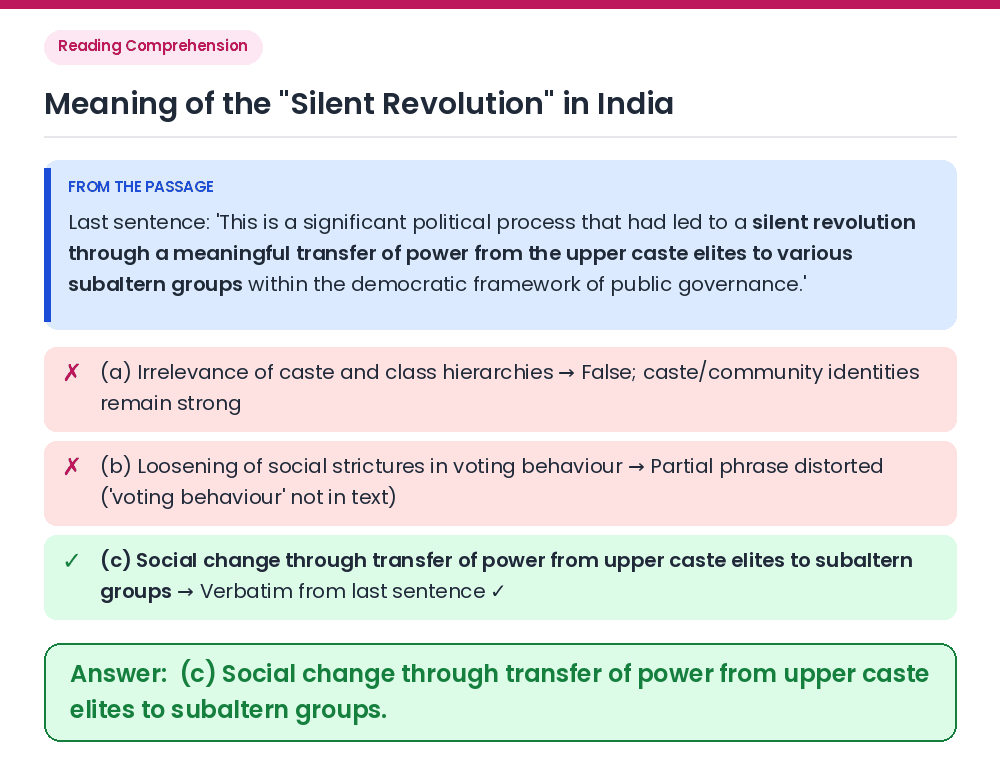
Answer: (C) Social change through transfer of power from upper caste elites to subaltern groups.
Concept: Locate the exact definition of 'silent revolution' in the final sentence of Passage 2. Passage Evidence: The final sentence states that the process 'led to a silent revolution through a meaningful transfer of power from the upper caste elites to various subaltern groups'. Eliminate a, b, d: Statement (a) contradicts the passage, and (b) adds 'in voting behaviour and patterns' which is not in the passage. Result: Option (c) is correct. Correct Answer: (c) Social change through transfer of power from upper caste elites to subaltern groups.